By Audrey Posten
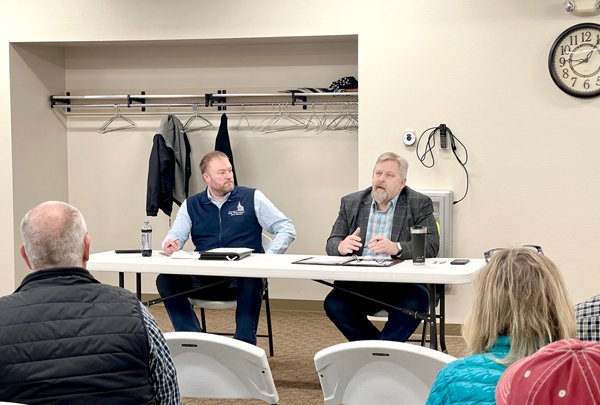
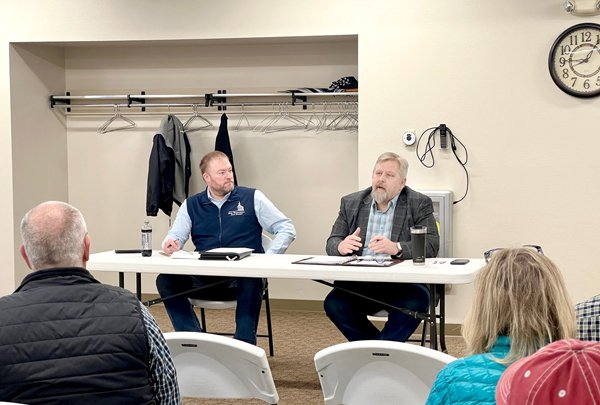
State House District 64 Rep. Jason Gearhart and Iowa Senator Mike Klimesh, representing District 32, weighed in on the current legislative session during a forum sponsored by the Farm Bureau at Luana Savings Bank on March 14.
Gearhart currently serves on the agriculture, natural resources and public safety committees and health and human services budget sub-committee. He is vice chair of veterans affairs.
Klimesh previously served on multiple committees, but this year is senate majority leader.
That means “I no longer serve on committees,” he explained. “The senate majority leader assigns all the committees, assigns all the committee chairs and gets to choose which bills come to the floor for debate.”
“It’s unique to have the senate majority leader position in rural Iowa,” Klimesh added. “It hasn’t been here in a long time.”
The legislators said the first funnel ended several weeks ago, and each chamber has been working to pass the other chamber’s bills ahead of the second funnel last week.
“Any bill that did not complete both chambers, other than some appropriations stuff, will be dead for the year,” stated Gearhart. “So a lot of voting the last couple weeks.”
According to Klimesh, property taxes are again a major focus.
“Last year we had conversations on property tax that we didn’t finish. So it was the senate’s goal, the house’s goal, and the governor’s office’s goal as well, to drop our legislation early in the session. Three different approaches, and there’s kind of some overlap in them. We’re trying to find consensus on issues,” he said.
Notably, the senate is proposing eliminating property taxes for those 65 and older who own their home. Other levels of reductions are being considered for older Iowans who don’t own their homes outright.
“We want you to own your home and not have to pay rent to the government,” Klimesh said. “But I hear a lot of consternation about that. How do we do that and maintain revenue streams?”
Klimesh said the senate is also proposing indexing the fuel tax, or tying it to inflation. It’s the primary funding system for construction of roads and bridges, and costs to build those have gone up exponentially since the last fuel tax increase in 2015, while revenue streams have flatlined.
If in place the past year, Klimesh said it would have “boiled down to half a penny per gallon…We’ve also given a provision that the legislature would have the ability, every year, to step in and stop that indexing from taking place.”
The house version, noted Gearhart, proposes a $25,000 exemption on residential property and would require 60 percent approval on all bonds that would be paid for with property taxes. It aims to clean up property tax statements and puts a 2 percent cap on city and county revenue.
“Right now, I think it’s going to be a mix of whatever leadership and the governor hash out,” he said. “If you ask all 150 legislators, they’ll come up with 150 different ways to solve property taxes. So many different ideas.”
Klimesh vowed legislators will not leave the capitol this session until a bill is agreed upon and headed to the governor’s desk.
“It’s something we’ve talked about for four years, and it’s time for us to get it done,” he said.
Funding came up in other questions for legislators as well. Referencing allegations of fraud at some Minnesota daycare centers, one audience member asked if similar instances have been discovered in Iowa.
Klimesh said internal reviews have been conducted, particularly in Health and Human Services.
“From my perspective, from the data I saw, I have no concerns about that level of waste, fraud and abuse,” he said.
Instead, the state is suggesting ways local governments can save money and potentially consolidate services.
Gearhart mentioned the house is working with a company that uses artificial intelligence to comb through levels of government—school districts, cities, counties—and their publicly available records.
“We’re looking at that for schools to help find efficiencies. That data should be out end of session, I was told,” he said. “If it’s successful with that, we could apply those same tools to HHS and our big departments that have massive budgets.”
Another audience member questioned if Iowa’s current flat 3.8 percent income tax rate is meeting expectations. Last week, Iowa’s Revenue Estimating Conference predicted, for the second year in a row, that the state would spend over $1 billion more than it would receive in revenue.
“Short answer, ‘Yes.’ Long answer, ‘No,’” Klimesh responded. “It’s complicated.”
He said extensive modeling was done on the 3.8 percent number, which took full effect in 2025, and that a cushion was built in. He also noted the state’s $6 billion in reserve funds.
However, Klimesh acknowledged the current economy and uncertainty of commodity prices doesn’t help.
“Farmers aren’t spending money. Iowa’s got a $200 billion GDP as a pool at large, and 30 percent of that is tied to the ag sector in some way, shape or form. Eleven percent is tied to the insurance industry, which has been having some issues too, whether it’s property, casualty or health,” he said.
The “One Big Beautiful Bill” federal legislation has also posed some challenges.
“We did not bank on no taxes on tips or overtime, which is about a $200 million hit to our revenue stream,” Klimesh explained. “The Medicaid hit, for us, is maybe larger than I anticipated it being. For SNAP, we would pay 25 percent of that and the Feds would pay 75 percent. They went to 50/50, and that’s about an $18 million hit.”
“But I have full confidence we’ll land where we need to,” Klimesh continued. “I have full confidence Iowa’s economy will regain its foothold.”
Klimesh is especially excited about geologic hydrogen exploration currently underway in the state—a topic that came up during discussions about eminent domain and property rights. A company called Koloma is studying the potential, which Klimesh said could support the production of ammonia—an important fertilizer element—in Iowa, controlling agricultural costs and generating revenue.
According to the United States Geological Survey, geologic hydrogen is hydrogen gas that is naturally found below the surface of the Earth. It is considered a clean fuel and sourced by and stored in rocks in the ground, similar to traditional petroleum resources.
Klimesh cited United States Department of Energy speculation that, under Iowa, “there could be 300 years of new energy resources with hydrogen.”
He said legislators want to be “sensitive about maintaining mineral rights, maintaining surface rights and protections, land restoration, capping of wells, while we don’t disincentivize the search.”
There are also plans to charge a severance tax on the hydrogen as it comes out of the ground. Klimesh said this would give Iowa the ability to tax a natural resource like other oil and natural gas states have for the past century.
“That will also set the table for Iowa to go down to a 0 percent income tax,” he stated. “We’re at 3.8. To go down a tenth of a point takes $150 million of new revenue. We have to find that revenue.”
“A severance tax on geologic hydrogen literally could change the face of Iowa—economically, industrially,” Klimesh continued. “There’s global markets for this. Japan is using ammonia for fuel cells to power their country and countries are changing over from diesel to ammonia to drive their large ocean tankers and delivery fleets. It’s an exciting time.”
After visiting with Koloma, and seeing their excitement, Klimesh believes it’s not a matter of if, but when, that happens.
“It will be a game changer for our state,” he said. “It’s important for us to get legislation, but it’s also important we don’t overly encumber legislation where they move out and say they’ll take their chances in Nebraska or southern Minnesota or other locations.”