By Kaitlyn
Kuehl-Berns
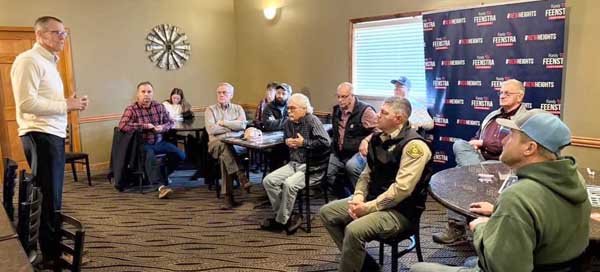
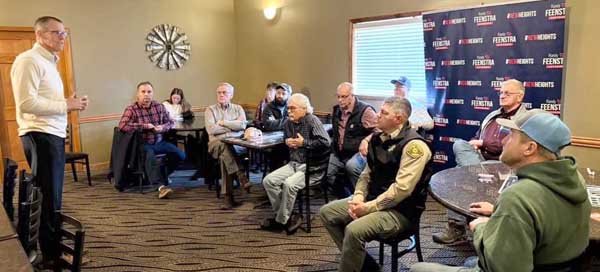
Randy Feenstra, a Republican candidate for Iowa governor, was in Elkader on March 10, for a Clayton County meet and greet as part of his statewide tour.
Feenstra currently serves as the U.S. Representative for Iowa’s fourth district, representing northwest Iowa. He is one of several Republicans seeking the party’s nomination in the 2026 primary election, which will determine who appears on the ballot in November.
When Feenstra arrived at Johnson’s Restaurant, he first went around the room and introduced himself to each of the approximately 15 guests in attendance. He then addressed the group and provided some background on his career and political experience.
“I grew up in a small town just like you—lived real life, had a real paper route, worked real jobs,” Feenstra said.
“I met my wife at the Pizza Ranch—we both worked there growing up. That’s where we met, and we’ve been married over 30 years.” The couple has four kids.
Feenstra originally worked as head of sales at Foreign Candy Company, located in Hull, before entering public service.
“I was traveling six days a week. When we had young kids, I realized I needed to be home—to be a husband and a dad,” he said.
Feenstra then began working as the Hull city administrator and later was elected Sioux County treasurer.
He entered state government in 2009, serving as a state senator until he was elected as the U.S. Representative for Iowa’s fourth district in 2021.
“I went from the fast-paced private sector to city administration, and that’s where I made the decision—I’m going to change government.”
During his time in Des Moines, he served on the Ways and Means, Appropriations, Agriculture and Education committees. From 2017 until 2020, he served as president pro tempore in the Senate, through which he helped set the agenda and guide legislation.
Feenstra highlighted his time on the Ways and Means Committee, working on tax cuts.
“I was in the State Senate for 12 years, and I was one of the ones who worked on lowering income taxes,” he said.
Since he has been in Washington, D.C., Feenstra has continued serving on the Ways and Means and Agriculture committees and has focused on tax policy, trade and rural communities.
“I worked with President Trump to write what we called the ‘Big Beautiful Bill,’ the largest tax cut in U.S. history,” he said. “I spent from January until June, every day, working on that bill, and there were so many good pieces in it.”
Feenstra also addressed broader political and cultural issues. “A man should never play in women’s sports,” he said. “When you’re born, you’re either a male or a female. Every life matters, whether born or unborn.”
Feenstra outlined his top four priorities for Iowa: strengthening the state’s business and agricultural climate, improving education, keeping young people in Iowa and expanding access to quality health care.
Speaking about agriculture, he said the state must continue reducing costs and supporting economic growth.
“I believe we have to become the most business and ag-friendly state in the country,” he said, adding that this includes lowering property taxes, reducing regulation and creating jobs while recognizing agriculture as the backbone of the state.
He also emphasized the importance of expanding markets for agricultural products. “We don’t want checks. We don’t want handouts. We want markets,” he said. “I was just on Air Force One with President Trump, and I told him that.”
Feenstra said education is another key focus, pointing to Iowa’s past success and the need to refocus on core subjects.
“We’ve got to get back to world-class education,” he said. “In 1987, when I graduated, we were number one in education in the country. We’ve got to get back to teaching.”
He also pointed to the amount of paperwork required of teachers.
“If somebody throws a shoe or says a bad word, you’ve got to fill out paperwork,” he said. “I just want teachers to teach.”
He said those priorities tie directly into his goal of retaining young people in Iowa.
“When you want to grow an economy, when you want to revitalize education, that helps to make sure our kids stay right here in Iowa,” he said.
On health care, Feenstra pointed to challenges facing rural communities.
“We’ve got to make sure there’ll be quality, accessible, affordable health care,” he said, noting long ambulance response times, maternity care closures and rising costs as ongoing concerns.
During the question-and-answer session, participants raised concerns about school funding and staffing. One attendee described budget constraints and unfunded mandates impacting local districts.
In response, Feenstra said he supported more flexibility at the local level.
“We’ve got to reduce regulation, reduce paperwork and allow more local control,” he said.
Recognizing his experience in government at multiple levels, an attendee asked how he would support cooperation across different levels of government.
“Right now, everybody’s working in silos,” he said. “Let’s work collaboratively instead of fighting.”
Another concern raised related to health care was the shortage of emergency medical services and volunteers in rural communities.
Feenstra said the state should consider changes to training requirements to increase participation and focus on getting patients to care more quickly.
“We’ve got to change the dynamic and make sure we get more volunteers,” he said. “Instead of 160 hours of training, maybe it’s 20 hours so people can respond.”
Another concern expressed by participants was how Feenstra would distinguish himself from other Republican candidates as well as presumptive Democratic nominee Rob Sand, Iowa’s current state auditor.
Feenstra responded by largely focusing on contrasts with Sand, repeatedly criticizing his positions and political alignment.
“We have to identify who Rob Sand is,” he said. “He has called himself an extreme liberal. That’s who he is.”
He also pointed to tax policy differences.
“He said it was a mistake that Iowa lowered income taxes…That’s a mistake? Are you kidding me?”
Feenstra’s visit to Elkader was one stop on a statewide tour as he continues meeting with voters ahead of the 2026 election.