By Bruce Thein
Tucked away into the park near Guttenberg’s fish hatchery stands one of the town’s most unusual historical features, a small stone grotto that has puzzled and intrigued residents for nearly a century.
The story of the Wolter Grotto was already making news in town by the spring of 1935. In its May 2, 1935 issue, The Guttenberg Press reported on the unique stone memorial being constructed in Ingleside Park by local resident and brewer Rudolph Wolter.
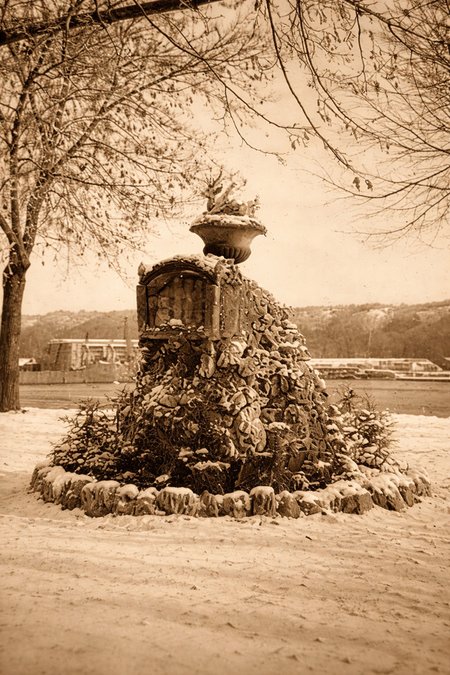
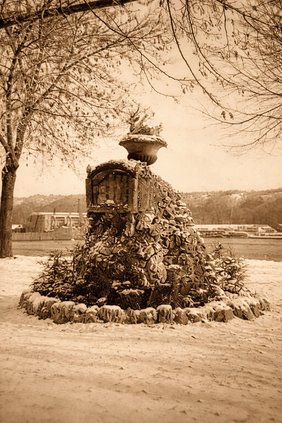
Wolter, assisted by his son Joseph, created the small stone structure using rocks he had gathered over many years. Located in what was then known as Ingleside Park, just across from what is now a dental office, the project gradually took shape as a carefully arranged mound of stones bordered with rock edging to give it a finished appearance.
At first glance, the grotto looks like a simple pile of rocks, but a closer look reveals a structure built with surprising detail and imagination. On the west side of the mound, Wolter constructed a grotto-like niche within the stones. The interior of the niche was decorated with shells, small rocks and fragments of pottery set into cement, giving the small space a decorative and almost artistic appearance.
The original display also included a striking figure. According to the 1935 Guttenberg Press description, a large figure of a Native American dressed in bright colored clothing stood beside a hunting dog, creating a picturesque scene intended to honor the Native Americans who once lived along the Mississippi River in this region. Over time, that statue has disappeared, but the stone structure itself remains.
Another fascinating detail about the grotto lies in the rocks used to build it. Members of the Wolter family traveled widely, and many of the stones incorporated into the mound were brought back from different parts of the country.
The 1935 article noted that rocks came from Yellowstone National Park, the Black Hills, Wyoming, California, Washington, D.C., Virginia and many other scenic locations across the United States. In that sense, the grotto became something of a miniature national collection, using stones from across the country gathered together in a small park overlooking the Mississippi River.
Nearly 90 years later, the grotto still stands quietly in the park south of the aquarium near the fish hatchery. Over the years, visitors have placed small objects and figurines inside the niche, adding to the curiosity and mystery of the grotto.
Unlike many monuments that commemorate famous people or historic events, the Wolter Grotto reflects something simpler – the creativity and dedication of a local resident who turned ordinary stones into a lasting landmark for the community. And thanks to a short article preserved in the May 2, 1935 issue of The Guttenberg Press, the story of how that small stone mound came to be has not been forgotten.