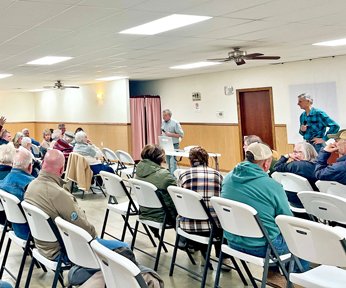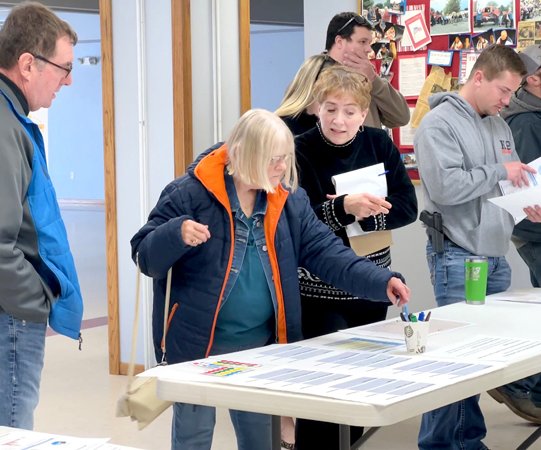
In conversations across the rural Midwest, the Federal Reserve Bank of Chicago has heard increasingly about the challenges of finding quality, affordable housing and of continuing a sense of civic life amid demographic changes. Despite such reports, some rural areas have succeeded in increasing housing construction and implementing economic development projects, thus improving access to affordable units and revitalizing communities. In October 2025, the Chicago Fed’s Community Development Team brought together a wide range of people working within the rural housing ecosystem for a bus tour across Iowa’s Driftless Area to build greater awareness of some of these successful efforts. Throughout the tour, we heard about how local leadership and strategic initiatives in the towns of Elkader, Waukon, Postville, Guttenberg, Maquoketa and Dyersville, as well as in the larger city of Dubuque, increased the housing supply and boosted economic and civic vibrancy.
The towns we visited range in size from 1,200 to 6,100 residents, according to the U.S. Census Bureau’s 2023 American Community Survey (five-year estimates). For this tour, we convened economic developers, small business owners, nonprofit professionals, lenders, foundation staff, regulators and government officials to exchange knowledge and identify successful examples of rural housing production and economic development projects.
As demographics
shift, so do housing preferences
Rural Iowa faces demographic shifts that will continue to reshape housing. Between 2013 and 2023, Iowa’s population declined in three of the six small cities we visited, while Iowa’s overall population grew by about 4% over the same time period. Relatively high out-migration and low in-migration, primarily made up of immigrants, have led to low population growth and aging populations for the state of Iowa, particularly in certain rural localities. These trends create a shifting basket of resident needs.
In a Dubuque City Council work session on housing, the president and CEO of the local development corporation noted that older large homes may no longer align with the needs and preferences of many residents. As baby boomers age, many wish to move off the farm and downsize into housing in town. While these moves may free up single-family homes for young families, a lack of affordable senior units can sometimes force older residents to leave their communities entirely in search of housing.
Waukon native and developer Ben Garrett described the challenge: “[For] an 80-year-old, moving 20 miles from Waukon to Decorah is like moving to a foreign country.”
Responsive to this desire to “age in place,” Garrett showed us Tailwind Duplexes, his 16-unit development with eight single-story duplex buildings that he hopes will attract aging residents who wish to stay in their home community, as well as current and future residents wanting a modern living environment.
However, demographic targeting of units may yield mixed results. Rose Garden Living, a multifamily development in Dyersville, was tailored toward residents aged 55 and older after the community identified a need for senior housing. Once on the market, the building attracted several out-of-town residents in addition to locals. The Landing, a new mixed-use, multifamily development built near downtown Dyersville, is now occupied by year-round residents, along with snowbirds, business travelers staying in company-owned units and tourists hosted through a vacation rental platform. From these two developments, we saw that when building new units, it isn’t always possible to predict who the new residents will be. This raises questions for local governments and community partners about the best ways to allocate public and philanthropic housing funds.
Before units come to market, small and aging communities must navigate the building process itself, as construction jobs can be hard to fill and federal housing subsidy policies can be burdensome to comply with. Of the developments we toured, two saw delays due to construction worker illnesses. One developer cited a federal procurement process that required bids from at least three different contractors despite the scarcity of builders in the area. Of the contractors that do exist in rural communities, many are small businesses with owners approaching retirement—which will mean there will be even fewer contractors in the future if no succession plans are in place.
Despite the demographic changes, many communities have identified opportunities to draw people back to rural communities. Members of some communities discussed the potential for attracting “boomerang kids,” defined by tour participants as individuals who grew up in rural Iowa, left for education or work and now wish to move back as adults. This group of “returning locals” can contribute to population growth that stimulates the local economy and housing sector. These returners may find a lower cost of living and a greater sense of connection, including a welcoming community for raising a family.
Local leadership can drive projects forward
With housing needs changing, people from rural communities discussed how strong local leadership—from elected and non-elected officials, nonprofit partners, lenders and entrepreneurs—is an essential component of active economic development and housing ecosystems. Local leadership is vital in recruiting partners and constructing the complex capital stacks necessary to fund projects, while trailblazing entrepreneurs and developers represent the critical spark that drives projects forward.
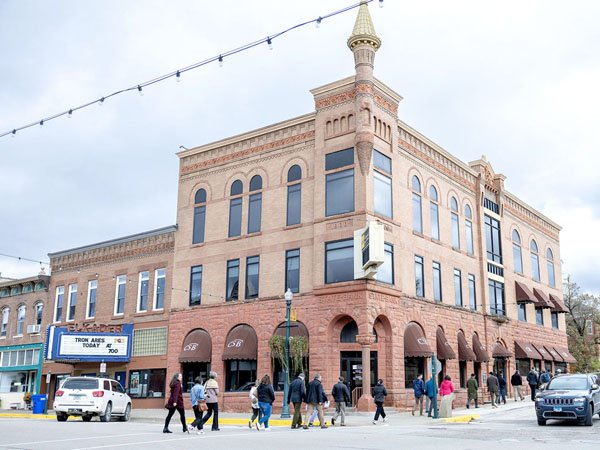
Some tour attendees noted the potential to renovate Main Street housing as another strategy to increase the housing supply and boost economic activity in commercial districts. In Elkader, we saw examples of rehabilitated upper-story housing in the heart of downtown that gave new life to aging housing stock. Through state and local assistance programs and administration of federal grants, the state of Iowa approaches upper-story housing rehabilitation as a potential strategy for small towns to repurpose existing historic structures. However, renovations may still be costly and dependent on multiple sources of financing.
Private sector initiative, usually in the form of small business entrepreneurship, is also essential in executing successful housing development. The Sheas, a husband–wife team in Elkader, got into development to provide new office space for the wife’s business and to update downtown buildings for upper-story rentals.
“We imagine nurses, teachers, young people living here—people not yet ready to buy a home but interested in coming to our community,” Caleb Shea explained of his units.
Shea also described parts of the renovation work he performed personally. Beyond Elkader, sweat equity was a common theme throughout the tour, as many jobs necessary for development were not accounted for in the budget and usually completed by the entrepreneurs themselves—everything from hand-crafted lumber coatracks to window-installs to building design plans. The Sheas have also taken advantage of federal and state funds to assist in their renovations. When asked if the couple would have undertaken the project without these funds, Shea replied, “No.” At the time of the tour, the downstairs office space was open and so was a business in the adjoining retail space. In addition, all the upper-story units had been rented. The Sheas said they have their sights set on refurbishing other buildings downtown.
Planning and analysis identify local assets and needs
On the tour, we learned that strategic planning can amplify the positive impact of strong local leadership. Planning frameworks and quantitative data used by local governments to guide investments in economic development and housing were key ingredients for success in some of the cities we visited. Advocates for these planning frameworks explain that identifying local resources and gaps better orient communities toward tactical, value-generating opportunities.
The Community Foundation of Greater Dubuque’s Community Heart & Soul initiative is one planning framework that focuses on identifying local assets (sense of public safety, educational programs and centers, vibrant commercial areas and welcoming culture) and builds consensus to direct future initiatives.
In Guttenberg, residents were proud to tell the story of the river lockmaster’s house, the last one remaining in its original location along the Upper Mississippi River. Originally the residence of the Guttenberg lockmaster, this structure now functions as the fully restored Lockmaster’s House Heritage Museum, celebrating local culture and town history.
Similarly, the 1903 Elkader Opera House had fallen into disrepair. The community restored the historic building in 2004. Now, the building houses a performing arts venue and city offices. Initiatives such as these restorations of historic sites can contribute to a sense of place that may help retain and draw residents, according to some local leaders.
Quantitative data can also drive conversation about and plans for local housing production. Omar Padilla, of Iowa State University Extension and Outreach, presented the Rural Housing Readiness Assessment (RHRA) during the tour. The RHRA provides education, analysis and a decision-making structure for local leaders to increase affordable housing availability.
Leveraging data produced by counties, the state of Iowa and the U.S. Census Bureau, Padilla and his colleagues create data presentations and reports for each city. They also conduct workshops and a community survey. Targeting their services to communities under 20,000 residents, the RHRA team has worked in over 60 Iowa cities, including Elkader and Waukon, and claims to have sparked nearly $160 million in housing investments, with another $118 million planned for the near future.
In contrast with Heart & Soul, the RHRA program focuses specifically on assessing housing needs and typically has a condensed timeline of three to six months. The plan produced may include recommendations on zoning, downtown housing and neighborhood revitalization. RHRA uses a cohort approach of assessing multiple communities in a single cycle, so cities can share challenges and insights with each other. In a recent statement announcing six new cities beginning the RHRA process, Padilla is quoted as saying the program (whose partnerships with these cities was funded by Empower Rural Iowa grants) provides “communities both structure and momentum,” noting “it’s not just a plan on paper, it’s a roadmap that helps local people move forward.”
Participants on the tour also echoed the point that many from our stops had shared: Find what a town does well and sell it. Following this guideline can help rural areas achieve their goals of bolstering local dynamism and a distinctive sense of place that may also attract more residents and economic activity.
Conclusion
We hear from people in rural communities that an adequate supply of quality housing is an essential piece of the puzzle of local economic development. As Padilla said, “strong housing options are the foundation of strong rural communities.” This tour identified regional assets in the housing and economic development spaces, including local leadership and strategic planning frameworks.
One key insight from the bus tour is that many of these strengths are place-based. Small-town assets and demographics are varied, and the successful implementation of housing development requires trusted relationships. Therefore, projects like the ones we saw may be difficult to scale or replicate in other communities. However, these projects provide a guide for other communities on how to identify local potential and design a course of action. Crucially, many people we spoke with told us that these developments would likely have been impossible without use of public funds—either municipal, county, state or federal funds and sometimes a combination of them. Public and private interest in implementing fundraising measures, such as TIFs, or risk tolerance for taking on debt, like by issuing municipal bonds to invest in ambitious long-term projects, may vary considerably by community.
Yet, cities can learn from the successful examples of housing and economic development that we saw on the tour. Fueled by strong relationships and leadership in the public, nonprofit and private sectors, inter-sectoral collaboration was common to many projects. Initiation of a city planning process that leverages both quantitative and qualitative local-level data can clarify strategic objectives. Exceptionally motivated entrepreneurs must identify opportunities and partner with local governmental, civic and private organizations to capitalize on them. Ultimately, people committed to rural cities have a unique opportunity to make a large impact.
This synopsis from the Chicago Fed’s Community Development team was authored by Elizabeth Berman, Brianna Smith and Dustin Ingram.