By Bruce Thein
Before the riverfront became a place for quiet walks and passing boats, it was a place of industry and for a time, Guttenberg was known for something most people would never expect: buttons. In the late 1800s and early 1900s, a small stretch of the Mississippi River helped turn Guttenberg into a working manufacturing town, built around an unlikely resource pulled straight from the river bottom.
In a September 6, 1899 issue of The Guttenberg Press, the arrival of the pearl button industry was introduced to readers as something both practical and promising. The paper described how shells from the Mississippi could be cut into blanks and shaped into finished buttons, a process already gaining traction along the river. It was, as the paper suggested, an industry that could give employment to many workers and make use of a resource that had long gone overlooked. The town was paying attention.
That same year, local leaders approved bringing a button-cutting plant to town, a move that would begin shaping the local economy almost immediately. The idea itself traced back to German immigrant John Boepple, who discovered that freshwater mussel shells could be used to make buttons. His methods spread quickly up and down the river and Guttenberg was ready to take part.
Over time, three button factories operated in town, each building on the last. The first plant, established around 1899 and often referred to as the Guttenberg Pearl Button Company, introduced the industry locally. It proved Guttenberg could support the work, even if the operation itself did not last long in its original form.
A second factory called the Montgomery Pearl Button Factory followed in the early 1900s, expanding production and creating additional jobs. Shells were brought in from beyond the immediate area as demand grew. The most successful and longest lasting factory was the Empire Button Works, established around 1909. Located along the river, Empire became the center of Guttenberg’s button industry and eventually its final surviving plant.
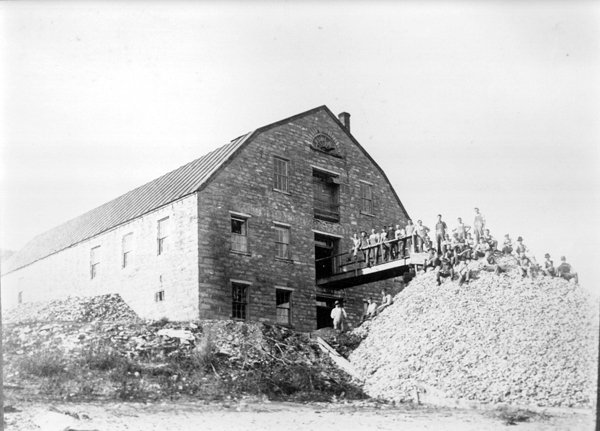
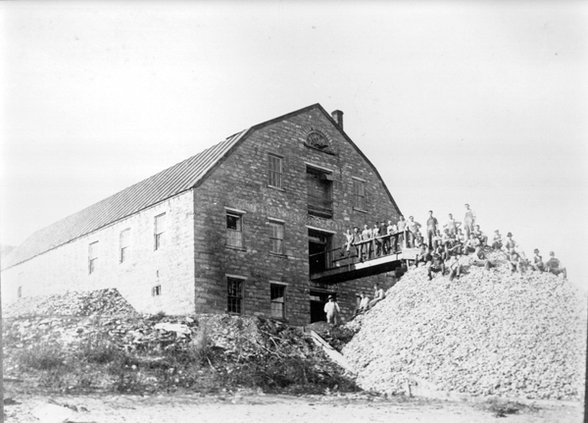
One of the most recognizable reminders of that era still stands today. The Empire Button Works operated out of the limestone building on South River Park Drive, the same structure now known as The Landing. Long before it housed a factory, the building had been constructed as a grain terminal by G.F. Wiest, one of Guttenberg’s early settlers. Its location along the river made it ideal for both purposes.
When it became a button factory, workers gathered there each day, turning loads of river shells into finished goods that were shipped far beyond Guttenberg. At its peak, the plant employed dozens, sometimes more than a hundred and ran multiple shifts. Workers would have arrived early, many of them local residents, stepping into long days of repetitive but skilled labor. It wasn’t glamorous work, but it was steady work. For a time, it connected Guttenberg to a much larger world, as finished buttons made their way far beyond the Mississippi River. Photographs from the time show rows of workers standing outside the building, men in work clothes, gathered shoulder to shoulder. By the 1930s, as economic conditions tightened, Empire had become the last button factory still operating in Guttenberg.
The factories depended entirely on the Mississippi River. Clammers dragged long bars fitted with hooks across the river bottom, pulling up mussels by the load. Barges filled with shells became a common sight along the shoreline. At the height of the pearl button industry, millions of buttons were produced from Mississippi River shells, a resource that once seemed almost endless.
Once ashore, the shells were cooked to remove the meat, which was often sold as bait. The shells themselves were sorted and sent into the factories. Every so often, a pearl would be found, imperfect, irregular, and unique. If a clammer was lucky, it went into his pocket.
Inside, the work was steady and demanding. Workers drilled circular blanks from the shells, then grounded and polished into finished buttons. The shells had to be kept wet for clean cuts, meaning workers often spent long hours with water running over their hands. It wasn’t easy work, but it was dependable.
The industry grew steadily through the early decades of the 1900s as pearl buttons were widely used and the town’s button factories played a role in meeting that demand. But by the 1950s, plastic buttons changed everything. They were cheaper, faster to produce, and didn’t rely on the river. The shift was quick and the old way could no longer compete. Eventually, the Empire plant closed and Guttenberg’s button town era came to an end.
Today, little remains of that industry, at least on the surface. But along the river, where people now pass by without a second thought, there are still quiet reminders of a time when Guttenberg played a small but meaningful role in a much larger story.