By Bruce Thein
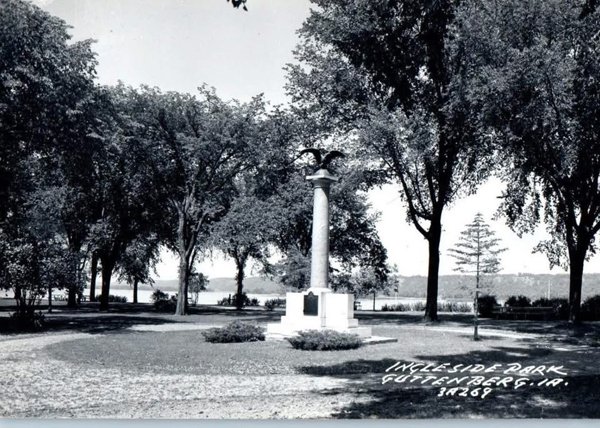
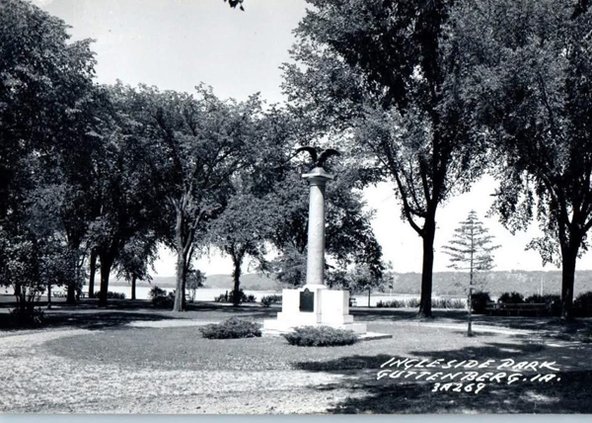
On Labor Day of 1921, the people of Guttenberg assembled in Ingleside Park for a celebration that combined patriotism, community pride, baseball, music and dancing. Residents gathered for the dedication of the Soldiers Monument, now known as the Veterans Memorial.
More than 100 years later, the Soldiers Monument still stands overlooking the Mississippi River, but the story of the day it was dedicated has largely faded from memory. Fortunately, the archives of The Guttenberg Press have preserved the details.
At 2 p.m. on the afternoon of Labor Day, a large crowd assembled in Ingleside Park for the formal dedication of Guttenberg’s Soldiers Monument. According to the newspaper, the event was well attended and enjoyed by all. The crowd was estimated to be over 500 people.
The monument itself represented more than a local project. It was presented to the citizens of Guttenberg by the Clayton County Board of Supervisors and paid for by the taxpayers of Clayton County. The monument was erected by B.W. James, a Guttenberg monument dealer whose work became a lasting landmark in the community.
The newspaper described it as “a fine structure” and noted that residents should feel proud of it because it honored those who had fought for liberty and “real Americanism.” Local leaders went even further, expressing gratitude to the Board of Supervisors and county taxpayers for providing what they called one of the best soldiers monuments in Iowa.
The dedication program featured several speakers and musical selections. The principal address was delivered by Judge H.E. Taylor of West Union. The Press praised Taylor as an outstanding speaker who could easily hold the attention of an audience. His dedication address focused on patriotism and Americanism and was reportedly well received by those in attendance. Other remarks were offered by E.W. Kregel of Garnavillo, chairman of the Clayton County Board of Supervisors, and by A.H. Borman of Guttenberg.
Music also played an important role in the ceremony. Patriotic songs were led by Max Mintzel, with Miss Clara Lake serving as accompanist. Community singing was a familiar part of public gatherings in the 1920s.
Among those attending the ceremony was Henry Torrey of Millville Township, a member of the Grand Army of the Republic and one of the last remaining Civil War veterans in the county. The newspaper specifically noted his presence and expressed the hope that he might remain with the community for many years to come.
It is easy to understand why the monument meant so much to those gathered that day. The Civil War had ended more than 50 years earlier. The veterans who had preserved the Union were growing older, and their numbers were steadily declining. Communities across Iowa and the nation were erecting monuments to ensure their sacrifices would not be forgotten when the last veterans had passed away.
The timing of the dedication is also worth noting. Labor Day 1921 came less than three years after the end of World War I. America was still processing the losses of that conflict. Nearly every community had sent young men overseas, and towns like Guttenberg would have known soldiers who had recently returned from Europe, or who never returned at all. That reality likely gave the dedication an added layer of meaning.
While the monument honored veterans of an earlier generation, those gathered in Ingleside Park were also witnessing the emergence of a new generation of veterans. The aging survivors of the Civil War shared the stage, in a sense, with men whose wartime experiences were still fresh in memory. One generation was being honored while another was taking its place in history.
After the dedication program concluded, attention shifted from the monument to the baseball diamond. A game was played between the St. Olaf Club and the Guttenberg Cooties. The contest drew a good crowd, and when the final out was recorded, St. Olaf emerged victorious by a score of 6-2.
As evening approached, the celebration moved indoors. A dance sponsored by the Guttenberg Baseball Association was held at Turner Hall. Music was furnished by the Jazz Kids Orchestra of Clayton, and the newspaper reported that a good crowd attended. What had started as a dedication ceremony had become a full day of community celebration.
The people of Clayton County gave Guttenberg a monument they believed was among the finest in Iowa. More importantly, they created a lasting reminder of the veterans whose service had helped shape both their community and their nation.
More than a century later, the Veterans Memorial, as it is now called, still stands in Ingleside Park. The crowd has long since dispersed. The speeches have faded into history. The baseball game has been forgotten except for one paragraph in the newspaper archives. The monument remains, continuing to do exactly what those gathered on Labor Day 1921 intended it to do: remember.