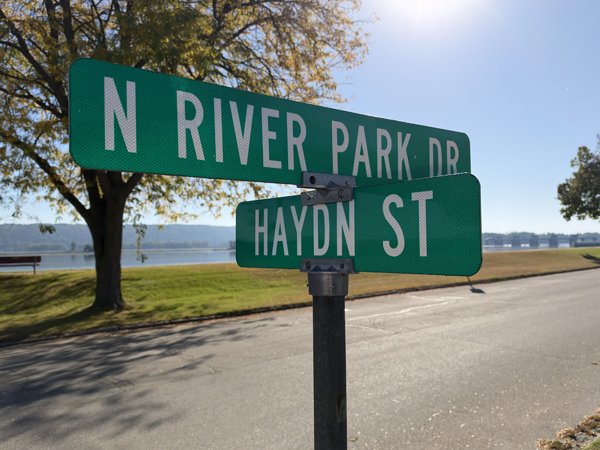
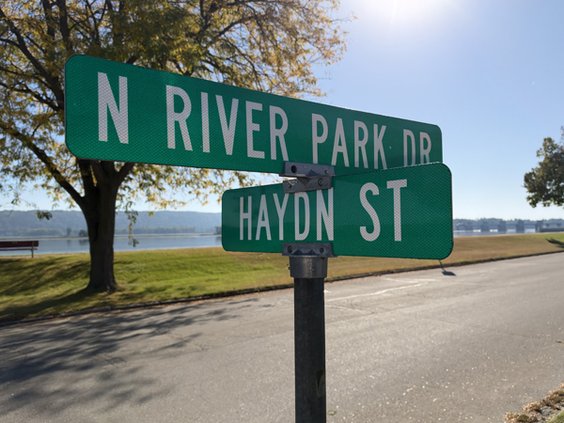
The community of Guttenberg, settled mainly by Germans in the 19th century, carries a visible legacy in its architecture as well as its community name and the name of its streets.
Schiller, Goethe, Kosciusko, Haydn...if you’ve ever wondered about the origins of Guttenberg’s street names, or tried to pronounce them, read on.
Famous German composers, writers, poets and philosophers were immortalized in signs on the east-west street corners of this small Iowa community, half a world away from the birthplace of their namesakes. Today we have lost touch with the achievements of those 19th-century figures.
The history of settlement in Guttenberg is a key to understanding the nomenclature.
The original town — the Village of Prairie la Porte — consisted of seven blocks that bore rather non-descript names: Prince, Pearl, Main, China and Regent; the exception being Pryam, presumably taken from a king in Greek mythology.
When the German Western Settlement Society arrived in the community, a majority of the newly-platted streets were named in honor of prominent Germans. Americans and Revolutionary War heroes were also honored.
Here’s a look at some of those names.
HAYDN STREET
Joseph Haydn was born in the small town of Rohrau, Austria in 1732. He is credited with being the “father of the symphony.” He was a friend of Mozart and a teacher of Beethoven.
A city ordinance in 1994 established the spelling as Hayden, but a 1995 ordinance dropped a letter, leaving the corrected official spelling as Haydn.
The proper pronunciation is “High-den.”
GOETHE STREET
Johann Wolfgang von Goethe, 1749-1832, was a poet, novelist, playwright, philosopher and diplomat. He is considered by many to be the most important writer in German language and one of the most important thinkers of Western culture.
The German pronunciation of this street trips up many local residents. Practice saying Gu(r)-tuh.
HERDER STREET
Johann Gottfried Herder (1744-1803) was a philosopher, clergyman and poet and was a friend of Goethe’s.
LESSING STREET
Gotthold Lessing (1729-1781) had a prolific career as a writer, philosopher, dramatist, publicist and art critic.
MOZART STREET
A composer who needs no introduction, Wolfgang Amadeus Mozart (1756-1791) produced more than 600 composition during his lifetime. He was a friend of Haydn’s.
SCHILLER STREET
Johann von Schiller (1759-1805) was a playwright. He has been called the second most important playwright in Europe after Shakespeare. Along with Goethe, he founded the leading theater company of Germany. The English pronunciation is Shill-er.
LAFAYETTE STREET
Marquis de Lafayette was a French military and political leader who, after conversations with Benjamin Franklin, decided to help the American cause in the Revolutionary War. He persuaded several French officers to come to America with him.
DEKALB STREET
General Baron Johann DeKalb was a compatriot of LaFayette’s and accompanied him to America to help fight the Revolutionary War. He served on Washington’s staff and helped command the troops.
KOSCIUSKO STREET
General Thaddeus Kosciusko was another European soldier who helped command American troops in the Revolutionary War. He was a native of Poland with French connections.
This street wins the local title for “most difficult to pronounce.” The traditional pronunciation is Kosh-choosh-ko.
WEILAND STREET
Christoph Wieland (1733-1813) was a German poet and writer. The German pronunciation of his surname is Vee-lant. Though the poet’s name is spelled Wieland, city ordinance changed the spelling to Weiland in 1994.