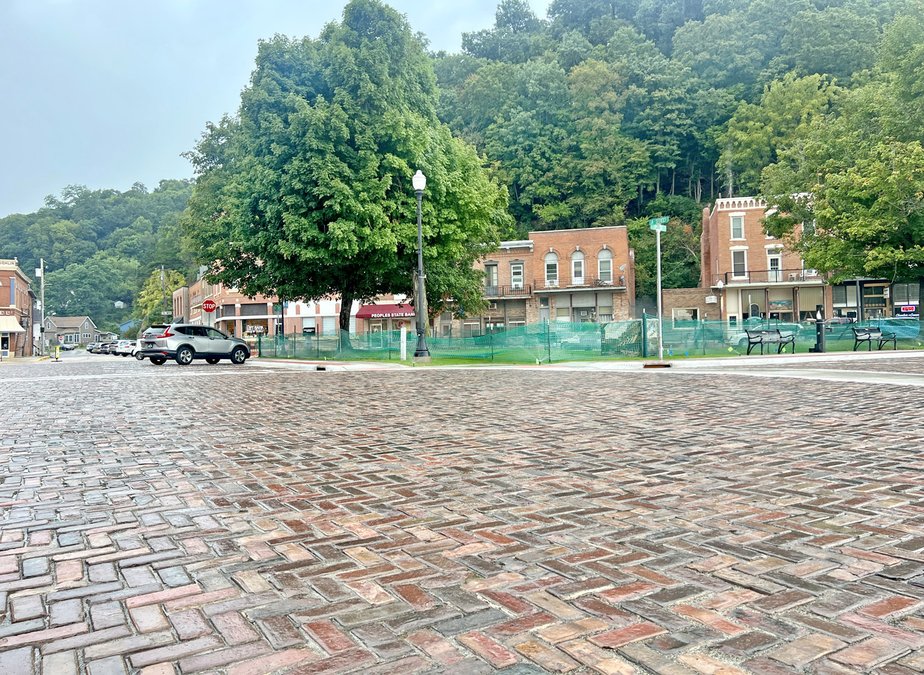
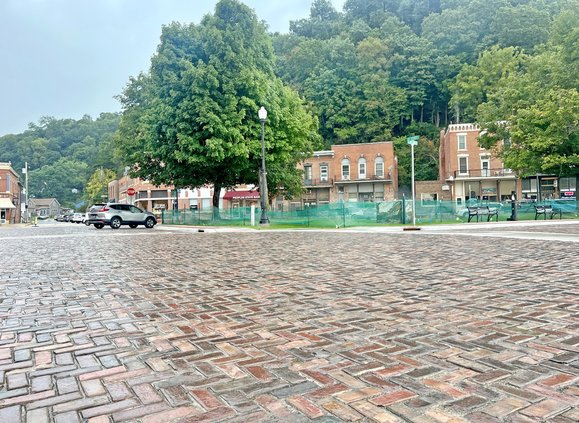
McGregor’s historic brick streets reopened to traffic early last week, the culmination of the four-month-long 1st and A Street Reconstruction Project that included reconstruction of the brick streets around Triangle Park as well as replacing sidewalk, installing curb and gutter, improving drainage and upgrading underground utilities.
Work addressed inflow and infiltration issues similar to what the two-year Main Street project combatted, and was critical in connecting downtown McGregor to the sewer plant, according to McGregor Economic Development Director Brandi Crozier.
“We really had to address the underground infrastructure. It was a serious problem,” she said, “but the road surface had also gotten hazardous.”
Crozier previously estimated it had been at least two decades since any repairs were made to the bricks that are a contributing item to McGregor’s National Register-listed downtown historic district.
To Duane Boelman, who chairs McGregor’s Historic Preservation Commission, the brick streets are one of the features that makes the district—and McGregor as a whole—special.
“They are just beautiful,” Boelman said. “We are fortunate to have city leaders who realize how important it is to the historic downtown and tourism we’re trying to support.”
The brick streets around Triangle Park date back to the same time Main Street, as well as a portion of Seventh Street, was brick paved in 1916.
The April 16, 1916 North Iowa Times announced “larger and more substantial improvements are promised for McGregor this season than have been made in any other year in a long time.”
Purington pavers, sourced from the Purington Brick Company in East Galesburg, Ill., were used for the project. A McGregor brick street timeline created by McGregor Public Library Director Michelle Pettit notes that, whereas most brick yards produced soft brick for constructing buildings, Purington manufactured heavy and solid paving bricks.
Work that began in April was expected to be complete by the end of July, but accounts from the North Iowa Times describe how a June flash flood hampered progress. Bricks were piled high on both sides of the street before the flood rushed down Main Street and scattered them everywhere, the newspaper said. The paving machine diverted flood waters into the hardware store, grocery store and other adjoining buildings, uplifting floors and shelves and almost completely wrecking these business places.
Instead, work was completed in September, with the newspaper telling how “Altogether 10 blocks have been paved, a total of about a mile…The cost is nearly $50,000.”
At the time, it was the first mile of paving in Clayton County.
Those innovative pavers continue to support McGregor’s historic integrity today, after being salvaged during the Main Street project for reuse in the 1st and A Street Reconstruction Project.
Curt Marx, a field technician with Davy Engineering, which oversaw both projects, said roughly 700,000 bricks in decent condition were removed from Main Street and taken to a site where a company later sorted, cleaned and palletized them.
“We estimated that, off of Main Street, ideally there would have been somewhere north of 850,000 bricks salvaged,” he said, “but many were broken. There were also areas that had been repaired on the street, so there weren’t bricks there anymore.”
According to Marx, the 1st and A Street Reconstruction Project pulled from just under 82,000 bricks of varying condition.
“They were kind of sorted by As and Bs,” he described. “Some of the bricks that are chipped, broken and not quite right, [the contractor] is using to make their cuts. So we don’t need a fully intact brick.”
Marx said all of the bricks previously around Triangle Park were removed from this project and taken to a city storage site for potential reuse.
“Even some of the bricks here that are cracked, too broken even to make a corner cut, they’re also going to that site,” he noted. “The remaining bricks from the Main Street project, as part of the agreement with the individual who sorted the bricks, are leaving.”
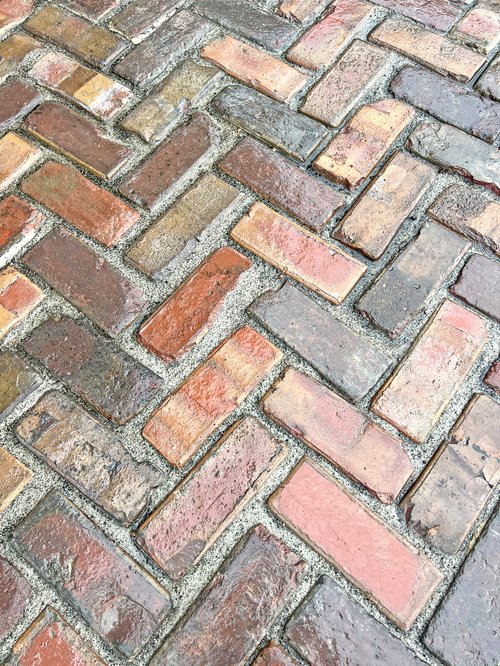
While the new old bricks around Triangle Park are the same Purington pavers, Marx said there are some visual differences to the bricks they replaced. The bricks from the Main Street project were encased in mortar, giving them a gray patina.
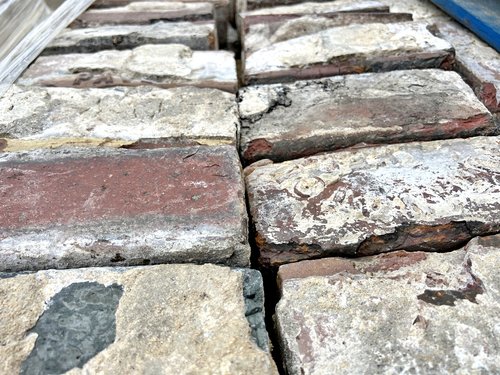
"They don’t have the dark red these had, although they should have,” he explained. “The top of them was asphalt, so we’ve got a little bit of that discoloration as well.”
“But the whole purpose of this was the old look,” Marx said. “If we wanted a new look, we would have gone with new brick.”
Whereas the previous bricks were laid in three distinct patterns—a line pattern, a herringbone pattern in the intersection, then a separate pattern for crosswalks—the brick was relaid in the traditional herringbone.
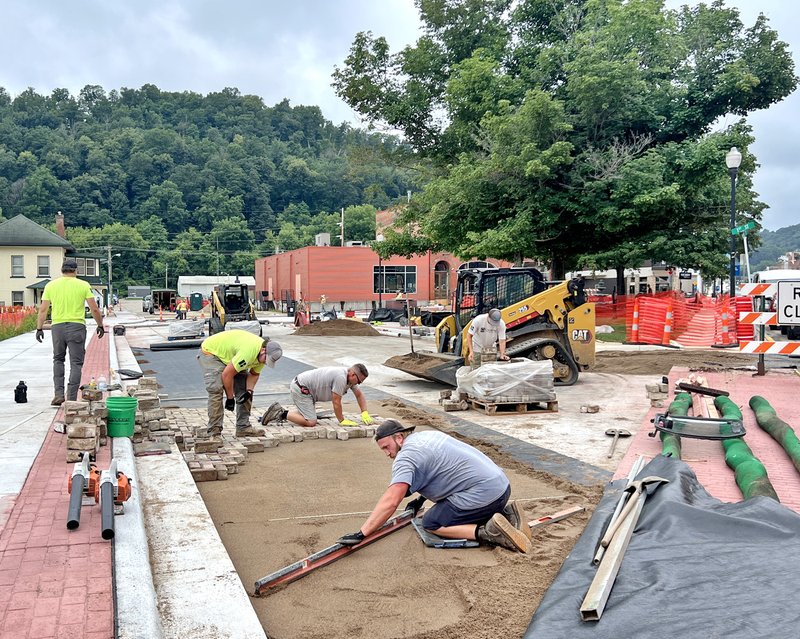
How the bricks were laid is also structurally different.
“Those [previous] bricks were placed in a mortar mix below, but it wasn’t a full thickness. It wasn’t a structural concrete. It was kind of a poured mortar and then they set the bricks on it,” according to Marx. “This is a steel reinforced, seven-inch modern concrete. You could drive on this surface forever and the bricks are actually going to spread the load out a little more. It is a very good support for the bricks.”
The bricks should also better withstand weather now. Water is designed to run off them, and the concrete has weep holes to collect any water that gets through the bricks and help it drain into the ground, Marx said.
The contractor has filled around the bricks with poly sand, which Marx stated is “actually a water-activated locking sand and almost forms a mortar. It locks these in very tight and it’s designed to shed water—not allow water to seep down through, to some degree.”
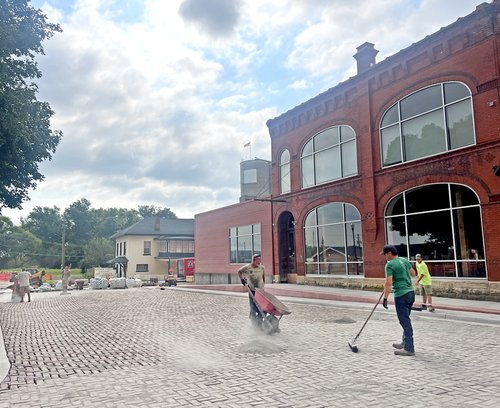
To further protect the brick streets, Crozier said weight limits will remain.
“And from a motorist standpoint, there will be no changes to parking or traffic patterns,” she added.
In his experience, Marx said preserving brick streets is rare for communities.
“I want to stress how much thought the city put into this. This is going to be a show piece,” he said.
Crozier called the brick street work—and the adjoining Triangle Park Enhancement Project—a “nice way to wrap up the downtown projects.”
Boelman agreed.
"These historic bricks have been serving the community for over 100 years, and it’s amazing how they can be reused—and really recycled. It’s great for the community and the earth,” he said.