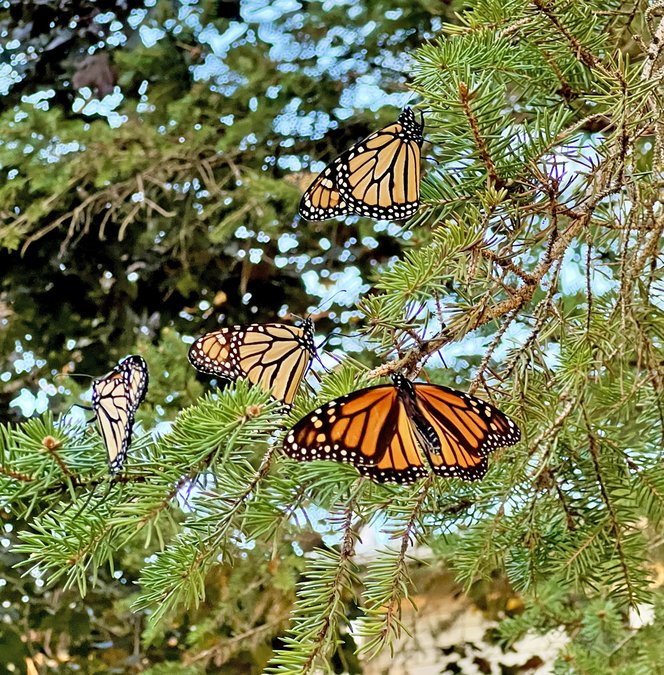
Walking among the trees in the Monona Butterfly Garden just before sunset on Sept. 11, one could see monarchs floating through the branches before coming to rest in groups. Some were in clusters of three or four, while others totaled six, seven or more butterflies.
Members of the monarch “super generation” whose lengthened life span and reproductive schedule differ from their parents, grandparents and even great-grandparents who emerged earlier in the summer, all were gearing up for the more than 3,000-mile-long migration south to central Mexico for the winter.
“This is the peak. We started seeing them about six days ago,” said Jim Langhus, who heads Monona’s Butterfly Gardens and Trails Committee.
The spot off Davis Street has been a haven for monarchs for decades. Langhus believes the valley, with its cool, moist air after sunset, is an attractant. Water in a nearby creek is important too.
“In some places, we’ve seen where the water feature is gone and the monarchs never come back,” he said. “If there’s no water in the creek, we don’t see them either.”
There are nearby nectar resources, supported by the Monona Butterfly Gardens and Trails Committee’s efforts in establishing a prairie area.
“We continue to add to that prairie, trying to do things to cut down on some of the invasive grasses, and get in more of the native grasses and native plants and flowers they like,” Langhus shared.
The trees, also, shield the monarchs from the wind and provide a five- to 15-foot comfort zone in which they prefer to roost.
“Some of the trees down here won’t have any roosting because they’re just so tall and straight,” Langhus explained. “But the lower ones, they tend to group up in. Then they will move to that five to 15 zone to roost for the evening.”
Langhus estimates 2026 has yielded the most monarchs in six to 10 years. All 100 of the tags bought to track the migrating butterflies have been used.
“We’re seeing a lot more this year,” he said. “There’s been a couple of years when we haven’t seen any. There’s one year we didn’t get one tag on. So we’re really excited.”
Langhus said it varies how long the peak will last. Feeding and weather play a role.
“If they are still going to gardens, feeding and coming back, it could be another two days,” he stated. “The big thing is that they will probably leave on the next north wind.”
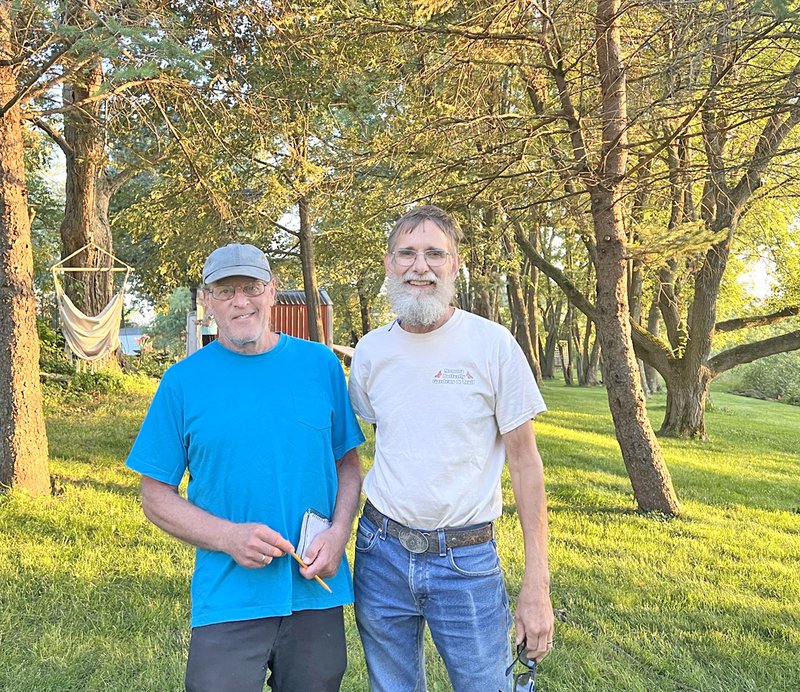
Retired professor Steve Forst is lucky he caught the monarchs in Monona when he did. He stopped in the community Friday as part of a 10-day bike ride from his home in Milwaukee, Wis., to southwest Iowa, following the migration.
Thanks to tracking sites like Journey North, Forst had seen Langhus’s online posts about monarchs in Monona, and believed it would be a good spot on his quest to see roosts.
Looking around at the butterfly-laden branches, “This has been excellent,” Forst said.
He’s long had an interest in monarchs.
“There’s something that’s charismatic about a monarch,” he reflected. “You kind of get pulled into it, and once you get pulled in, you want to be involved in doing things with monarchs. And the migration is the thing that pulls you in the most, because there’s something miraculous about it—the idea that they don’t know where they’re going, and they’ve never been there before. How perilous the trip is. And they’re going to end up in this small little location. It’s just so fascinating.”
Forst travels around 50 miles per day, on local roads and trails, then camps overnight. A friend is driving the same stretch with him, and the two meet up for lunch and in the evenings.
He believes traveling by bike helps him better understand the monarch migration.
“You migrate about the same speed on the bike—12 miles per hour, on average—and that means you are moving with monarchs. You catch the environment they’re migrating through. Also the winds,” Forst explained. “When you’re in a car, you don’t feel it. But if you’re plowing through the wind—you know what direction the wind’s going and how much force there is, and you have to make decisions about how you ride and stuff like that—that’s what the monarchs do. If they’re going into a headwind, they’re hunkering down. But if they have a tail wind, they can go 100 miles in one day. They’re really tuned into the winds.”
Although following just a segment of the journey this year, Forst dreams of some day seeing more. Maybe even the winter roosting site in Mexico.
Ultimately, he hopes the trek is not only educational, but inspires others to support monarch habitat and nectar sources.
“If they’re migrating, they need a lot of energy. If we have too little nectar sources, they’re not going to make it. So there’s a conservation aspect. That was part of the reason I wanted to get on my bike,” Forst said. “Monarchs are a charismatic insect that we like, but a lot of the insect populations are going down. If you put in more nectar and diversify environments, you can help. So it’s to raise awareness.”
Places like the Monona Butterfly Garden show the power—and beauty—of these efforts.
“This has been a very special stop, because you never know when the monarchs are going to start to migrate and accumulate. You get lucky sometimes,” Forst said.