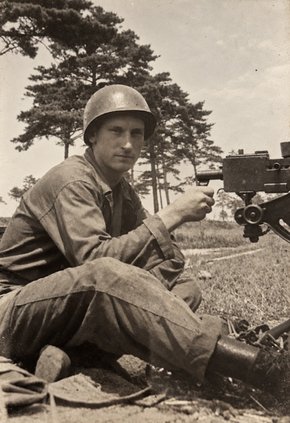
By Bruce Thein
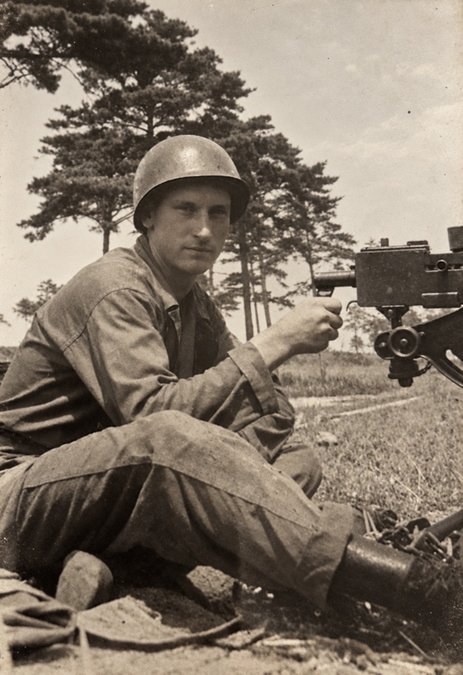
He entered the United States Army in late October 1944. Within months, he was on a ship crossing the Pacific Ocean and that same year he was climbing steep mountains under enemy fire in the Philippines. He was not an officer or a commander but a private. He was not a man whose name would appear in history books. Just a private in World War II.
He served in the 43rd Infantry Division, known as the “Winged Victory” Division, and fought in Northern Luzon in 1945 during the liberation of the Philippines.
The 43rd landed at Lingayen Gulf in January 1945. From the beaches, infantry units pushed inland into mountainous terrain north of Manila. Japanese defenders occupied high ridges and fortified cave systems. They chose ground carefully. Every advance by our infantrymen required climbing into danger.
Northern Luzon was steep, thick with vegetation and unforgiving. Rain turned trails into mud. Narrow ridgelines exposed advancing troops to machine gun fire. Mortars echoed throughout the valleys. Progress came slowly, yard by yard, ridge by ridge.
A private in an infantry regiment during that campaign was a rifleman. He carried an M1 Garand. He carried ammunition and grenades. He dug foxholes in rocky soil. He moved forward when ordered and held ground when told to hold. When artillery landed, it landed near him. When machine guns opened up, he was within range.
The Combat Infantryman Badge was awarded only to infantrymen who personally engaged the enemy in active ground combat. It was not given for being stationed overseas or assigned to a combat zone. It was earned in the line of fire. This private earned it.
The two bronze stars on his Asiatic-Pacific Campaign Medal signified participation in two designated campaigns in the Pacific Theatre. The Philippine Liberation Medal confirmed his role in the effort to free the Philippines from Japanese occupation. Those ribbons alone describe months of hardship. But there was another medal. The Silver Star.
The Silver Star is the nation’s third-highest decoration for valor in combat. It is awarded for gallantry in action against an enemy of the United States. It requires documentation, witnesses and approval through the chain of command. It is not given lightly. For a private in Northern Luzon to receive the Silver Star means that, in one decisive moment, he did something beyond ordinary duty.
Perhaps he advanced against entrenched fire when others were pinned down. Perhaps he held a critical position under counterattack. Perhaps he rescued wounded comrades under direct enemy fire. The official citation records the exact act. But the medal itself tells the essential truth, when the situation demanded courage, he responded. Not because of rank, but because of resolve.
He also earned the Army Good Conduct Medal, inscribed with “Efficiency, Honor, Fidelity.” Even in wartime, discipline and reliability mattered. In combat, steadiness saved lives.
Like thousand of others, this private returned home after the war. He stepped back into ordinary life, like work, family and community. He did not build his identity around medal or recognition. The generation that fought World War II rarely did. The ribbons remained quietly in a drawer or a box, small pieces of fabric and bronze that carried enormous weight.
History often remembers generals and grand strategies. But wars are fought by young men climbing hillsides with rifles in their hands. They are fought by privates who advance uphill into uncertainty because they are told to advance. They are fought by individuals whose names may never appear in textbooks but whose actions shape the outcome of battles. World War II was filled with such men. This private was one of them.
That private who entered the Army in October 1944, fought in Northern Luzon with the 43rd Infantry Division, earned the Combat Infantryman Badge and the Silver Star, and came home in November 1946 was my father, Private August Thein.