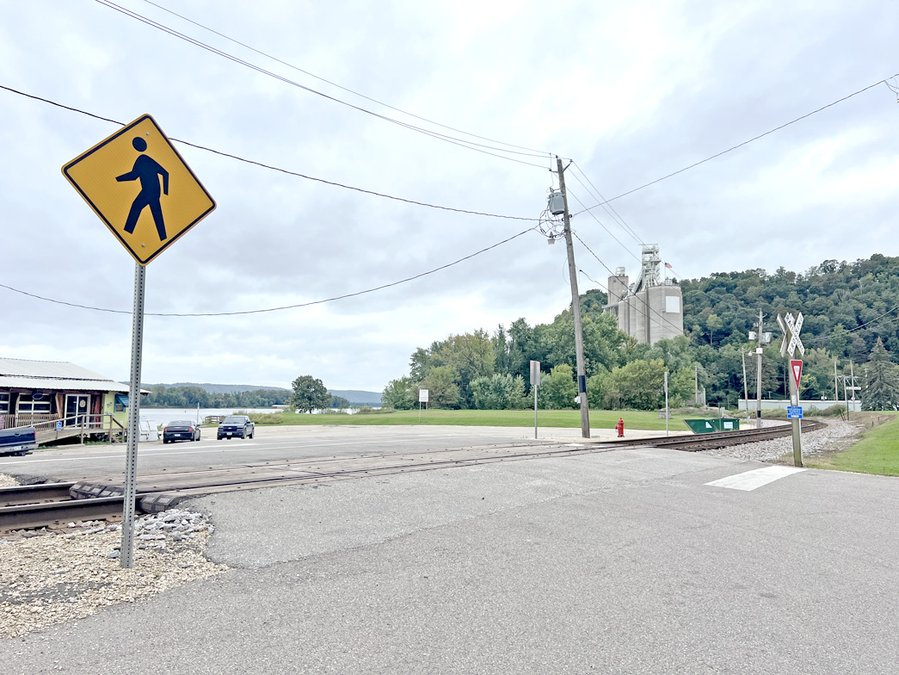
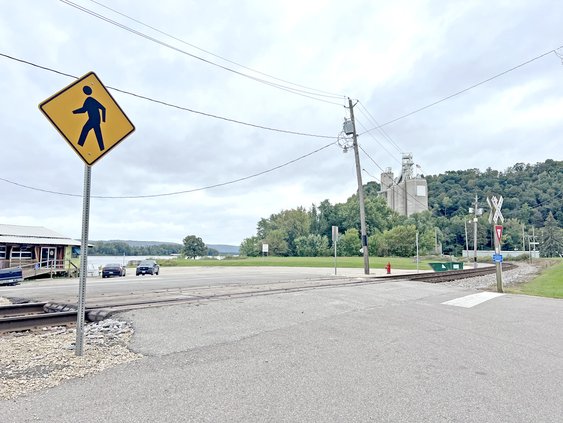
In the coming months, the city of McGregor will have to determine if it wants to take advantage of federal highway funds to update the existing railroad crossing at the foot of Main Street, pursue relocating the crossing to the area behind Kwik Star or take no action at all. The city council learned more about the potential options during its regular meeting on Sept. 16.
Discussion began earlier this year, when the city learned a Section 130 project application submitted several years ago by previous administration was being considered.
“Several years ago, the city reached out with concern about the rail crossing and the safety there,” Kristopher Klop, manager of highway-rail grade crossing safety programs for the Iowa Department of Transportation (DOT), told the council.
The Railway-Highway Crossings (Section 130) Program is federally funded, he said, with Iowa allocated $5.178 million annually to improve railroad crossing safety. Crossings like McGregor’s, with lower average daily foot traffic compared to roadways considered in other applications, normally aren’t funded. But Klop said awareness of safety issues prompted the Iowa DOT to present it as a caveat project to the Iowa Transportation Commission, which approved it.
In addition to the typical lights and gates at the crossing, Klop said improvements would extend the public sidewalk/walkway and erect fencing to support pedestrian safety.
“Because pedestrians are crossing the tracks and the roadway, we were going to add a sidewalk just to the south, so they can get out of the road when they cross the tracks,” Klop said. “In order to channelize them to that pedestrian crossing, because it was noticed there were a lot of people crossing the tracks to get to the gas station and the restroom—and that’s obviously illegal and a safety issue—we would add some fencing.”
Fencing would go out 100 feet on either side of the road, requiring the city to extend it down the railroad right of way.
“That will actually make it effective. Otherwise people will just go down the other side of the fence,” Klop said.
Additionally, since the signal house that controls the mechanisms for the crossing could only be placed where the public restroom is currently located, the public restrooms will be relocated as a qualified expense.
Klop noted the only cost to the city would be the additional fencing. Everything else would be 100 percent federally funded.
However, the city is currently unsure whether it wants to proceed with the proposed improvements. CPKC has been considering replacement of a railroad trestle bridge in the vicinity—work the city could potentially tie into for flood control measures. Development plans are also in the works for the former Holiday Shores/Trilogy property on the riverfront, now owned by Jeff and Jenifer Westphal.
City officials indicated those eventual plans, as well as safety concerns for motorists and pedestrians at the current crossing location at the curve of the roadway, could make relocating the crossing desirable.
“Right now, on busy weekends, you’ll see people queuing on either side of the tracks and it gets complicated. As we get more visitation in town, we can anticipate that could become more challenging,” said McGregor Economic Development Director Brandi Crozier.
The relocation option proposes closing the existing crossing at the foot of Main Street and instead having one behind Kwik Star, as an extension of A Street. This option would include replacing the existing trestle bridge with an at-grade crossing and addressing stormwater issues in that area through a retention pond and pumping station.
“If we are able to go from A Street, it’s a little safer,” said mayor Anne Kruse. “If the crossing moves, think of A Street that goes in front of the former Old Man River. You would just keep going. Boats and trailers and people going to the riverfront would go that direction instead of having to cross on that curve of the highway.”
Patrick Dunn-Drees from RDG Planning & Design, who was representing the riverfront developers, said the conceptual design process for the riverfront is just beginning.
“We’re about a month into a six- to eight-month process. In theory, by spring we would have conceptual designs that would be preferred and recommended,” he shared. “The existing crossing, along with other potential locations, are all being considered within the conceptual design process. At this point, we don’t have any insight on if any changes would be recommended. We need to go through the process with our client and other stakeholders.”
There’s no guarantee CPKC Railway will approve a relocation, however.
Ryan Nonnemaker, director - U.S. Government Affairs for CPKC Railway, said, “We are in the business of closing crossings, not opening new ones.”
After preliminary looks at replacement of the trestle bridge, he said the railroad is now taking a step back in consideration of the potential crossing work and riverfront development.
“Before we get to what’s next, we need to know what the game plan is,” Nonnemaker said.
Ultimately, the city of McGregor could also take no action, opting to leave the existing crossing and related infrastructure as is.
Either way, Klop said he would need to know by this spring.
“The federal funding is only good for five years from the time we request it from the FHWA, so we’re already almost a year into it, and these projects typically take four to five years to complete anyway,” he explained.
If the city pursues moving the crossing, these funds could not be applied toward it; the city would have to resubmit an application. The funds would then be applied to a different project.
“So in order to keep moving forward, we need some direction from the council,” Crozier said.
No decisions were made at the meeting, but Crozier was instructed to continue gathering information to give the council a clearer picture of feasibility, potential costs and available resources before any decisions are made.