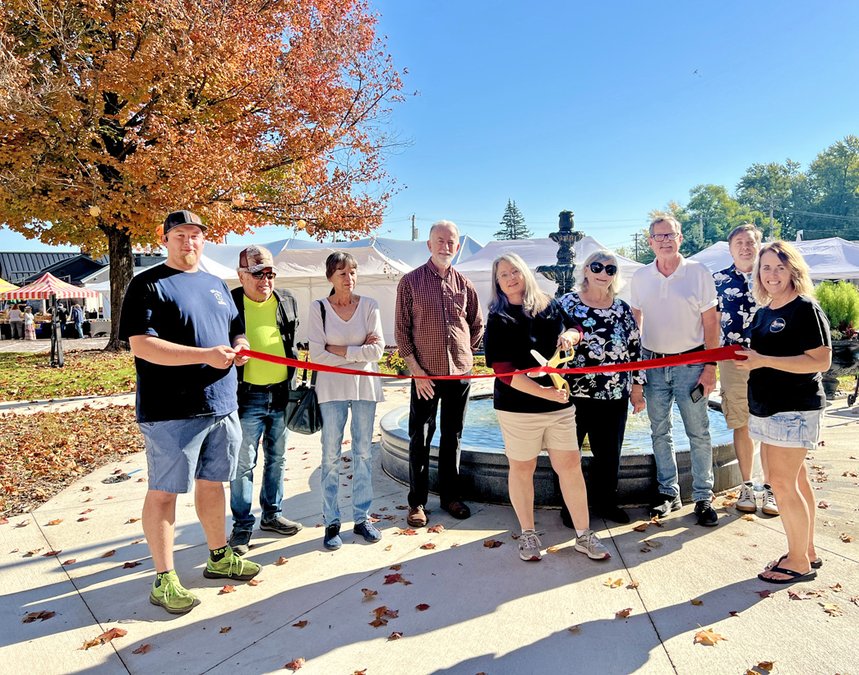
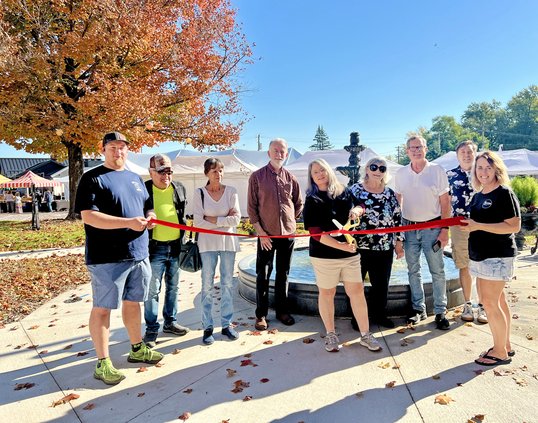
McGregor city officials, staff and board volunteers, as well as professionals who helped bring the projects to fruition, celebrated completion of the enhancement of Triangle Park and reconstruction of the historic brick streets along First and A Streets during a ribbon cutting on Oct. 10. The occasion kicked off the McGregor Fall Art Festival which, in its move back downtown this year, showcased the improvements.
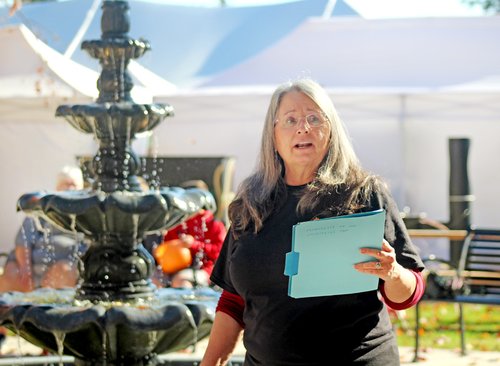
In a speech before the ribbon cutting, McGregor Mayor Anne Kruse said it might be easy to see these simply as construction projects—new bricks, a new fountain and new landscaping and sidewalks.
“But what we’re really celebrating today is the result of years of planning, partnerships, community input and a shared vision for downtown McGregor,” she said.
The seeds for the projects were planted several years ago, when the city council identified both the brick street reconstruction and Triangle Park enhancements as priorities within the city’s urban renewal plan.
They were later included in McGregor’s community master plan and part of the conceptual designs developed in the year-long Iowa’s Living Roadways Community Visioning process, with assistance from the Iowa State University Community Design Lab.
From there, an ad hoc committee made up of representatives from the McGregor Park Board and Pocket City Progress Committee spent several months looking closely at Triangle Park.
“They considered what should stay, what needed to be refreshed and what new elements could make this historic space more functional, welcoming and useful for generations to come,” Kruse described.
At the same time, city staff began working with Davy Engineering to turn the vision for First and A Streets into an actual construction project—working through the engineering, infrastructure, drainage, utilities and technical details necessary to preserve the character of the historic brick streets while rebuilding what was beneath them.
The vision for Triangle Park also moved forward when Iowa State faculty members Julia Badenhope and Chad Hunter secured funding through the National Endowment for the Arts for the Mending and Bridging project, a collaborative effort with McGregor and Marquette that focused on strengthening community connections and using thoughtful design and placemaking to help bridge the communities and public spaces.
Ideas were translated into conceptual images and helped the city seek professional landscape architecture services from Ritland+Kuiper, who worked with city staff and the Parks and Green Spaces Committee to prepare the project for construction.
Through the process, several aspects remained important.
“Triangle Park needed to remain Triangle Park. It needed a fountain. We wanted to preserve as many of its mature maple trees as possible. And we needed to address one of the park’s longstanding challenges: creating turf that could withstand everyday public use while allowing this space to serve as a gathering place for community events,” Kruse said. “Those priorities helped guide everything from the selection of a substantial new granite fountain intended to serve this community for generations, to the soil remediation and landscaping work designed to support both the health of the trees and the long-term usability of the lawn.”
Behind the scenes, countless hours were spent figuring out funding, engineering, bidding, permitting, utilities, schedules and how to coordinate two significant projects happening side-by-side in a historic downtown—all while trying to minimize disruption to businesses, residents and visitors.
Kruse credited McGregor Economic Development Director Brandi Crozier for her work throughout the process.
Also noted were general contractors Tschiggfrie Excavating for the First and A Street reconstruction and Bacon Concrete for Triangle Park, and the many subcontractors, tradespeople and partners who brought everything together. That including J&J Hernandez, Country Landscapes, Pat’s Electric, Davey Tree Service, McGregor Municipal Utilities and the city public works crew.
“One partner who deserves special recognition for helping us bring all of those pieces together is Davy Engineering,” Kruse added, with special recognition of Curt Marx. “Davy was involved long before construction began, helping the city work through the engineering and design of the First and A Street project and, ultimately, helping us coordinate two separate projects that were very much intertwined.”
Additionally, Kruse thanked the downtown businesses, property owners and residents for their patience, flexibility and cooperation.
“None of this happened because of one person, one committee, one grant, one contractor or one city council. It happened because a lot of people kept showing up,” she stressed.
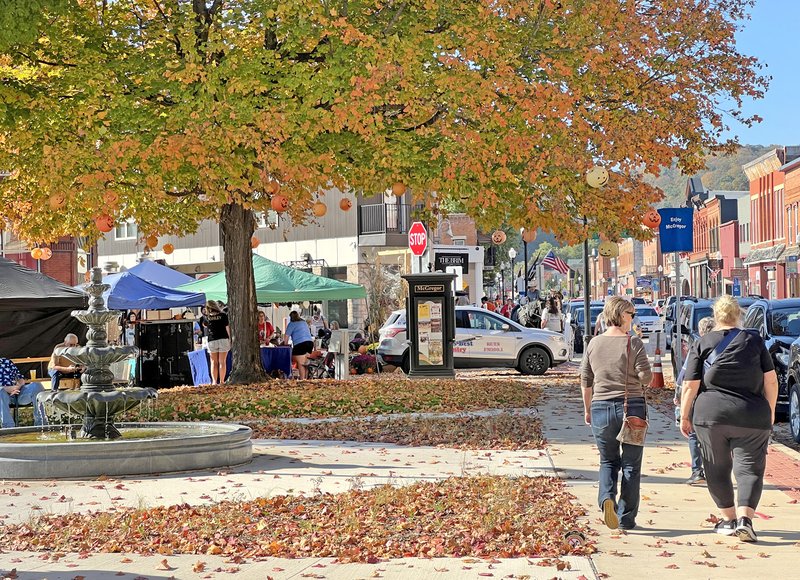
The Triangle Park and brick street projects were also enhanced by an opportunity that came along while construction was underway. Through the Iowa Arts Council, McGregor was selected to participate in the Creative Places Accelerator program, giving the community new resources and support to begin intentionally incorporating public art and creative placemaking throughout downtown.
Some of that work is already visible, including an art piano and artistic wrap on the park’s large utility box. Additional elements are still to come.
Throughout September, the Creative Places group also brought music downtown every Saturday afternoon with concerts from the balcony above the chamber office, “bringing people together around music, art and this newly enhanced public space,” Kruse said.
While the projects are completed, they, in many ways, mark the beginning of a new chapter as well, according to Kruse.
“Triangle Park and our historic brick streets will continue to evolve as people use them, as public art is added, as events grow around them and as new private investment takes shape on nearby development sites,” she said. “That’s really what good public investment should do. It shouldn’t simply improve a street or renovate a park. It should preserve what matters, solve problems that need solving and create a foundation for what comes next.”