By Audrey Posten
An experiment launched to the International Space Station in October has Guttenberg connection.
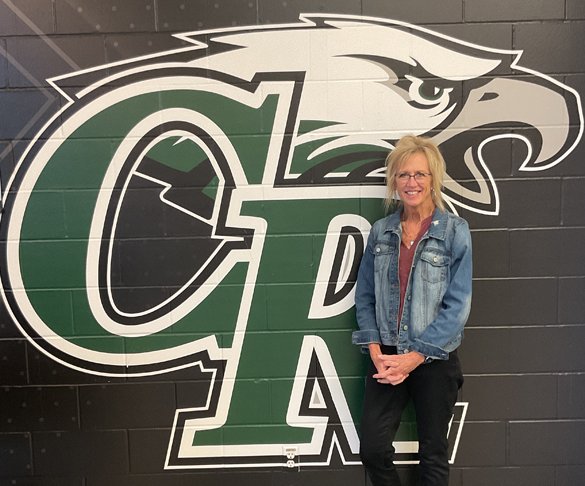
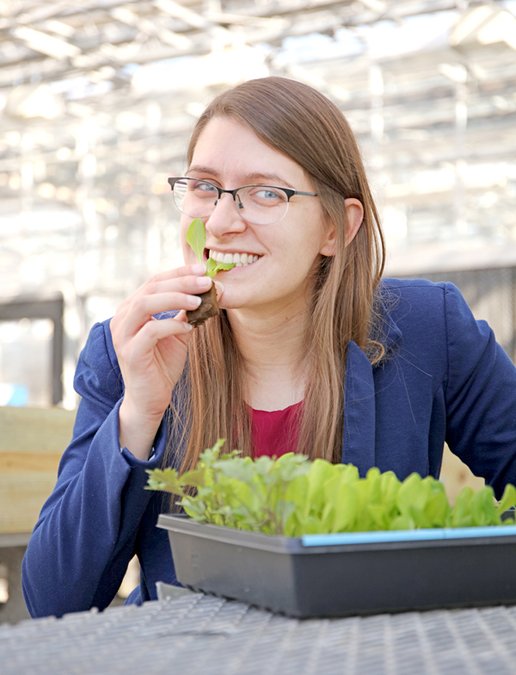
Part of a winning proposal submitted by University of Tennessee students Devin Vitello and Nathan Tucker for the Student Spaceflight Experiments Program, the experiment investigates if those traveling to space could grow plants for food. The two submitted their proposal while taking a space research class taught by 2010 Clayton Ridge graduate Kellie Walters, an associate professor of plant sciences.
“Coming from Guttenberg, I didn’t realize everything you can do. When I started my job, I didn’t think I would do anything for NASA,” Walters said. “But I think everybody who knows me knew I was always really passionate about plants. Then you do a really good job and work hard and, all of a sudden, we have a plant experiment on the space station.”
Walters didn’t imagine her career would take this trajectory when she headed to college at Iowa State University. After being heavily involved in FFA in high school, she planned to be an agriculture teacher. But she had a love of plants, too.
“When I was at Iowa State, I realized you could actually major in horticulture and just work with plants,” she said.
Walters had multiple internships and experiences in the field, from teaching horticulture in the U.S. Virgin Islands and St. John to stints at the Iowa Arboretum, a Seattle greenhouse and apple orchards. With graduation on the horizon, she assumed she’d work in a greenhouse or nursery.
A newer professor at ISU encouraged her to attend graduate school instead. Walters’ research focused on floriculture crops—flowering plants—as well as hydroponic culinary herbs like basil, cilantro, parsley and dill.
“But when I was done with my master’s, I still didn’t know exactly what I wanted to do,” Walters admitted.
So she pursued her doctorate, this time at Michigan State University. There, work continued to include culinary herbs and floriculture crops, but Walters also researched how to alter the production environment in greenhouses and vertical farms.
“Whether that’s the amount of light, the light intensity, the light quality, or the color, temperature, air temperature, root zone temperature, interactions between these, and a plethora of other experiments,” Walters described. “As you pull these different levers, you can drastically alter how fast plants grow, the resource inputs. You can change how plants tastes.”
Take basil, for example. Even with the same genetics and seeds, plants grown under low light conditions versus high light conditions differ drastically. One you can barely taste, while the other tastes as strong as black licorice.
“So I did a lot of work with how do you grow these plants the best way possible, most efficiently as possible. But then pairing that with consumer perceptions of flavor and quantifying the compounds that contribute to flavor, so a lot of analytical chemistry work as well,” Walters said.
Following graduation, Walters began her position at the University of Tennessee, located in Knoxville, in fall 2020. While a considerable part of her job is research—she’s had over 85 people working in her lab in different capacities the past six years—Walters also teaches.
Her interest in NASA began when a plant scientist mentioned plant production for space.
“I was thinking about what I could do differently that other people aren’t working on. There are not many people in the U.S. or many in the world who do both the production side of controlled environment agriculture and the analytical chemistry piece. We do a lot of analytical chemistry work in my lab to really figure out what’s going on from a biochemical perspective,” Walters said. “I really wanted to dig into that because no one was doing that. I realized that could be my specialty.”
Brainstorming ways to bring in research funding, she thought, “I want to do research for NASA.”
The first federal grant proposal Walters wrote was a single principal investigator proposal on leafy greens nutritional quality—more specifically, optimizing that nutritional quality based on how it’s grown. The research was funded and several papers were published.
At the same time, Walters was considering creating a new class called space research. Funding from an endowment in the Herbert College of Agriculture for experiential learning helped support participation in the Student Spaceflight Experiments Program which helps facilitate the payload to the International Space Station.
Walters said the class met only on Wednesday nights. It covered previous space experiments, limited not only to plants.
“We had a lot of guest lectures too—folks who retired from NASA or NASA contractors in different ways,” she added.
Students worked in groups of two or three, learning how to write grant and research proposals.
“We had a full competitive process with a grant review panel reviewing them, picking the top three, and then we sent the top three to a national panel. They selected the top experiment, but I was able to secure the funding in advance that one group from class was able to have an experiment on the space station,” Walters said.
The chosen experiment was relatively simple, according to Walters, because it focuses on seeds and the effects of radiation and gravity on seeds. To prepare for launch, the experiment was placed in a little tube, kept cold and overnighted to Houston. Staff there reviewed it and made sure everything was secure, before sending it to the Kennedy Space Center, where it was loaded on a SpaceX rocket.
“This rocket launched on Tuesday, Oct. 13, at 6.33 a.m. It was in cold storage that whole time, and didn’t dock on the space station until Thursday morning sometime. So it took a couple days to get there,” Walters said. “Then it took a little bit for them to unpack everything. We received an email when they removed the experiment from cold storage. Every time there’s an action taken, they tell us. Then we can do the same thing to our ground control, because you need to have a control experiment here on the ground. If you’re growing plants, it’s a similar kind of thing.”
Walters said the experiment was anticipated to be on the International Space Station for four to six weeks.
She called the experience inspiring.
“Seeing these students, it just makes my heart so happy. And hopefully we’ll continue. We still have some other research proposals out with NASA that we’re waiting to hear back from,” she said.
Walters believes networking and exploration are important. Her advice for others, whether they are conducting research, starting a business or following a dream, is not to put yourself in a box.
“You don’t have to look at what everybody else is doing and follow that. If you could do anything, what would you want to do? And if you’re really good at something, and you go about it the right way, you can probably make it happen. You start reading papers and coming up with ideas and see where there are gaps and how you can address them. Sometimes it’s knowing the right people—the one person who connects you to another, that connects you to another,” Walters said. “Have a variety of experiences, and put yourself out there. Travel and meet different people.”