By Audrey Posten
The Guttenberg Public Library is learning more about the value and care of the Gutenberg Bible facsimile on display there.
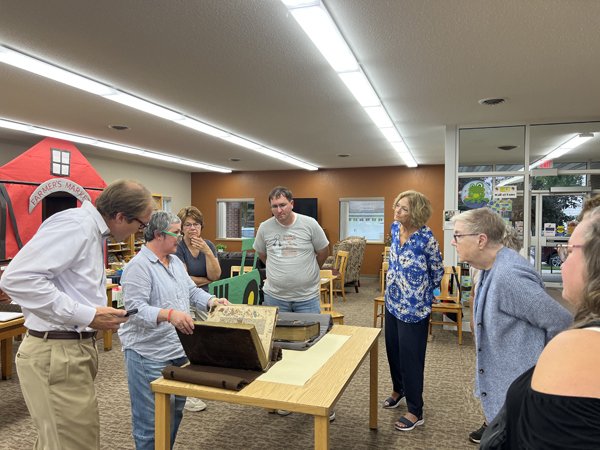
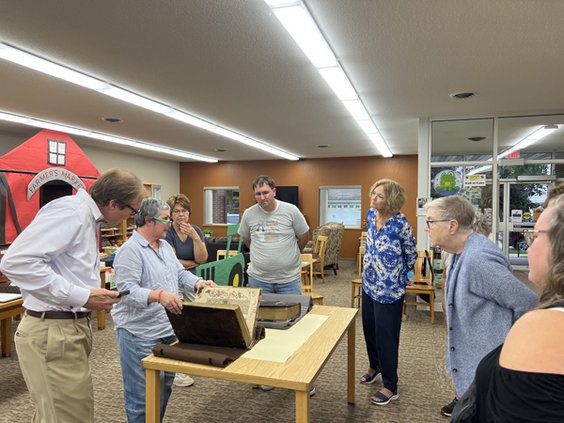
Appraiser Jon Thompson and Giselle Simón, conservator at the University of Iowa Libraries, shared preliminary thoughts with library staff, board and foundation board members, as well as city officials, during a meeting on Sept. 17.
Guttenberg Public Library Director Katey Simon said this was prompted when Dr. Charles “Chuck” Millham formally gifted the two volumes of the Gutenberg Bible facsimile to the city of Guttenberg in April 2025.
“The conditions of that gift were that the volumes remain displayed and under the care of the Guttenberg Library; that they remain insured against theft, vandalism, weather and fire; and that they not be sold,” Simon said.
At the time of the gifting, Millham conservatively estimated the volumes were valued at $32,000, or $16,000 per volume.
“With inflation, that was based on the amount it was purchased for, which was $2,800 in 1946,” according to Simon.
The volume of the Gutenberg Bible on display at the Guttenberg Public Library is one of a two-volume set which Charles Millham purchased in the 1940s from the Gutenberg Museum in Mainz, Germany. Millham was the former editor and publisher of The Guttenberg Press, and learned of the opportunity to purchase it from town historian Walter Jacobs, via a letter from Guttenberg native Lavern Moser who was then assigned to military intelligence work. They were told the museum was willing to part with a facsimile set that had been damaged, in return for financial help toward rebuilding its building and displays.
Millham originally loaned the bible to the Guttenberg Library to put on display—an arrangement continued by his son, Chuck Millham.
According to the library, the volume on display is not one of the Gutenberg originals (of which there are 46 copies still in existence). It is one of a two-volume set of an edition of 310 facsimile sets printed at Leipzig, Germany, in 1913 by the Insel-Verlag. Using a copy of an original, Insel-Verlag reproduced it with modern printing methods.
This facsimile copy was on display in the Gutenberg print shop in Mainz during an air attack on Aug. 12, 1942, and as a result, the covers and some pages along the edges of the volume were damaged by fire and water. However, it was decided not to rebind the book or trim the burned portions because its survival through the bombing was an important part of its history.
Facsimile copies of the Gutenberg Bible, like the one in Guttenberg, are considered rare books. They are scattered throughout the world.
“There have been recent sales of a couple of them. Generally, they’re in Europe,” Thompson noted.
With such a treasure in its possession, Simon said the library wants to assure it’s using best practices for caring for the two volumes.
The Sept. 17 meeting was the first time most in attendance had seen what the books looked like outside their case near the library entrance.
Thompson and Simón were excited for the opportunity to learn about the bible as well.
“It’s a good idea to update appraisals. It should be documented what their replacement value is,” Thompson said. “I’m thrilled to be part of it.”
While viewing the volumes, Simón was most interested in conservation—and thus book structure.
“Obviously, we want to preserve the history, the fact this was in a bombing, that it has suffered fire and water. That is something we would try to keep intact,” she said, “but there’s also other things you can do to stabilize something so it can be opened and closed and the structure can still operate. Katey also asked me to talk about the case and how you might think about possibly getting a better case for the future, for its long-term preservation.”
Simón saw no evidence of “intervention” over the years. To find original bindings is rare—and good—she said. “That gives us a lot of information about its life and provenance.”
Her assessment revealed typical binding from that period. “Definitely a luxury binding, or higher priced publication in terms of binding,” Simón noted.
She felt the binding itself has done an amazing job of protecting the text. Despite some fire and water damage, as well as surface dirt and debris inside, a majority of pages were white and in good condition. They show beautiful hand drawn flourishes along with the printed words.
There is also no evidence of mold.
“It think that is a testament to the quality of this facsimile and the paper that was used. And the care that was given. Yes, it was in a blast, but someone took care of it. Someone was able to rescue it,” Simón said.
Thompson remarked on that too.
“I’m really pleased at how the pages are so clean. I was surprised by that,” he stated.
Although Simón offered suggestions that night, she said the library should ultimately engage a conservator to further assess the Gutenberg Bible facsimile and help the library carry out a care plan. Until then, she said efforts might go toward a new case that is taller and can accommodate the books not being cast flat open. Cradled support and stabilization for the books is also important.
“The long-term housing of something, to me, is the most important thing,” Simón said.
Additionally, she suggested the library monitor the books’ environment, including temperature and humidity within the room.
“Data can help you look at that and control that. Making sure it’s not being subjected to extremes,” she said.
Currently, a light is not illuminated above the bible unless someone wants to look at it. Simón believes that’s a good practice that should continue.
The library can further support the books by turning pages every month or so, rather than leaving it open to one page for long periods.
“That gives the one page a rest. And you’ve got many pages to look at,” Simón said.
She commended the library’s care so far.
“You’ve done a great job preserving it up to this point, and it’s going to be fine until you’re ready to go to the next level,” she shared.