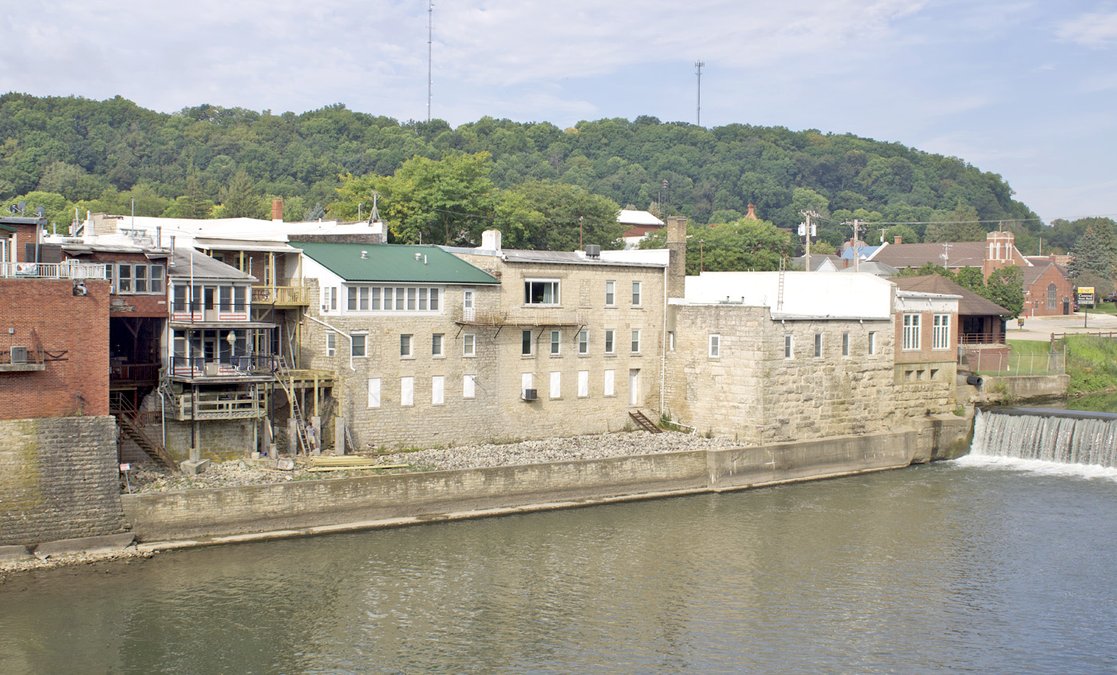
Property owners along North Main Street in Elkader have addressed the city council at recent meetings to discuss possible improvements behind their buildings.
The considered improvements would be on the river terrace area owned by the city of Elkader. This piece of property was acquired along with the dam and former Interstate Power Company building at 130 N. Main St., which now houses the Elkader Public Library.
At the Aug. 10 meeting, Eric Grau and Carol Muller, who own the building at 112 N. Main St., where the newly opened River Sounds Co-op is located, shared their interest in developing an easement that would allow them to install a concrete surface on the section of city-owned property directly behind their building, between it and the river.
The river terrace area originally had a limestone wall, but after damage from a large tree during the 2008 flood, the city replaced it with a concrete wall and stone veneer using $208,004 in FEMA funding. Because the property and flood wall are publicly owned infrastructure, the city was eligible to receive federal disaster assistance for the restoration work. After flooding in 2016 washed away gravel behind the wall, the city received another $24,410 from FEMA to replace the material. The city was required to use larger riprap rock to better withstand future flooding.
Council member Randy Henning raised concerns about installing concrete on only one section of the property. If floodwaters overtop the wall, he said, water could undermine the concrete, potentially causing a section to break loose and damage other buildings or the bridge downstream. Other council members joined Henning in expressing interest in seeing improvements planned consistently across the entire section rather than one property at a time.
Discussion continued at the Aug. 24 meeting, when Joe and Nancy Smelter, owners of 126 N. Main St., where they operate Elkader Mill on Main lodging, joined Grau and Muller in addressing the council.
The Smelters were also interested in improvements to the city property behind their building. Approximately 85 feet of the roughly 145-foot river terrace runs behind their property, with the remaining approximately 60 feet divided among the other three buildings.
The property owners said they had been communicating about the area and were generally on the same page about the type of improvements they would like to see. They discussed coordinating the work and dividing costs among the four properties, including potentially covering costs for portions where an individual owner might not be able to undertake the same level of improvement.
As they investigated improvements to the area, including a previous proposal for a raised deck, the Smelters encountered challenges with engineering requirements. Joe Smelter said they had contacted four engineers, and three declined to take on the project. The engineer who developed a plan could not agree with their contractor on the structural requirements and cost.
Safety was another consideration, including whether a railing would be needed along the river side of the terrace. Smelter suggested that, if the city required a railing, there should be discussion about whether the city could participate in its cost.
Council member Tony Hauber raised broader questions about using publicly owned riverfront property in a way that would only be accessible through the adjoining private businesses.
Hauber said he supported improving the area but wanted to ensure public property continued to provide value to the broader public. Although the city does not currently provide formal public access to the terrace, people do enter the area, including to fish. Hauber also raised concerns about permanently giving up publicly owned riverfront property and what opportunities the city might have for the area in the future.
The property owners questioned how general public access could practically be provided given the configuration of the buildings and lack of a safe public entrance to the terrace.
For the city to grant an easement for improvements on the property, the affected area would need a legal description, and proposed improvements would require engineering review to address safety, flooding and liability concerns. Because the property is publicly owned, granting an easement would also require a formal city process, including a public hearing before final approval.
At the Aug. 24 meeting, the council voted to indicate its intent to provide an easement over the city property, provided the required process is followed, a legal description is supplied by the property owner and an engineer determines the proposed improvements do not pose a liability risk to the city. Council members Bob Garms, Henning and Curtis Ruhser voted in favor, while Hauber voted against. Roger Buchholz was absent.
Discussion included additional considerations at the Sept. 14 meeting, when the council was tasked with determining how to address a deck that had recently been constructed without a permit behind 122 N. Main St. Because it was unclear whether the deck was located on private or city property, the city arranged for a survey before determining how to proceed.
That survey was completed ahead of the Sept. 28 council meeting and found the building lines essentially serve as the private property lines. The deck behind 122 N. Main extends onto city property, with the surveyor reporting it reaches at least six feet beyond the private property line.
With the property boundaries clarified, conversation has shifted from primarily discussing easements to considering the potential sale of the city-owned land behind the North Main Street buildings.
Preliminary council discussion indicated members would be open to selling portions of the property to the adjacent building owners. If an owner did not wish to purchase the section directly behind their building, council discussed allowing the adjacent property owners on either side to potentially divide and purchase that section. Council members indicated they would not sell the property to someone who did not own an adjoining property.
How the city would proceed if only one property owner wanted to purchase the section directly behind their own building remained unclear, and some property owners have already indicated during previous discussions that they may not be interested in purchasing the land.
The city would retain ownership of the flood wall along the river. Additional details would need to be determined before any sale could move forward, including the exact boundaries of property that could be sold, continued access to and maintenance of the flood wall, requirements for improvements in the floodway and which of the adjacent property owners are interested in purchasing land.
No property sale or easement has been approved, and the city will continue conversations with the property owners to communicate the information received through the survey and determine their interest in proceeding.