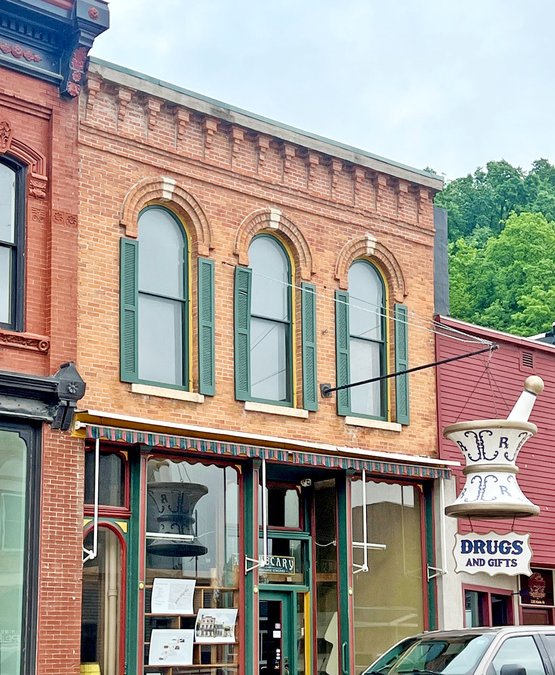
In his decades as McGregor’s pharmacist, it wouldn’t have been uncommon for Larry Brummel to handle delicate medications or carefully examine containers to assure prescriptions were being safely prepared and dispensed to patrons.
That’s why, when he stumbled upon unknown containers in the basement of the building at 230 Main St. just a few years after taking ownership in 1976, he understood the situation should be handled with care. But little did he know the discovery would become what wife Maria jokingly refers to as “the day Larry saved McGregor.”
Larry estimates it was the early 1980s. He was poking around for bottles.
“I like old bottles and stuff like that,” he shared. “I was in the basement, which has a dirt floor and the old storm sewer runs right along the back. It was dark and dingy down there—three light bulbs lit the place up. So I had a flashlight.”
Standing along the back wall, something caught his eye. There were cardboard containers with metal tops, not dissimilar to other older prescription bottles or “boxes.” Larry picked one up. On the side it read, “potassium cyanide.”
“I put it down very gently,” he recalled. “There were multiple cases of it. 96 pounds.”
As he made his way back upstairs, Larry thought, “‘What are we going to do with 96 pounds of potassium cyanide?’”
Luckily, Larry and Maria knew the son of a friend who worked at a laboratory. He put them in contact with another person who could help dispose of it.
Through the process, the Brummels learned the potassium cyanide had years before been sold to stores like drug stores and hardware stores, likely as a pesticide.
“The main use was rat holes and gopher holes. You sprinkle it, and water on top of it would turn the powder to gas. The gas is heavier than air so it goes down into the ground,” Larry explained.
There was no indication how long the potassium cyanide had been in the basement, exactly why it was there or why there was so much.
But it was nothing to mess with.
The Centers for Disease Control and Prevention (CDC) physically describes potassium cyanide as white in color, a granular or crystalline solid that looks similar to sugar.
“Potassium cyanide releases hydrogen cyanide gas, a highly toxic chemical asphyxiant that interferes with the body’s ability to use oxygen,” exposure to which through ingestion, inhalation or skin absorption can be rapidly fatal, the CDC added. It is used commercially for fumigation, electroplating and extracting gold and silver from ores.
The man who was going to help dispose of it arrived on a Friday, driving a Cadillac and dressed in a three-piece suit, Larry remembered. The two went to the basement.
“We get down there and he says, ‘I’ve never seen this much cyanide in one place at any time.’ He couldn’t believe it,” Larry said.
Someone would have to come back, but luckily, through a government agreement, it could be done at no cost to the Brummels.
The following week, the potassium cyanide was removed.
“He put on a full HAZMAT suit, mask, long gloves that went up to his armpits,” Larry said.
The truck parked behind the pharmacy, as the alley was open then. The Brummels believe that’s likely how the story has stayed under wraps all these years. The North Iowa Times never reported on it, and it didn’t make the town gossip mill.
“I don’t think anyone in town knew what was going on,” Larry said.
The Brummels have shared the story occasionally over the years. It’s unique, they said, but also sobering to think what could have happened. Although the basement rarely had water in it, the space was still damp and could have activated the potassium cyanide.
“But we are all still here to tell the story,” Maria said.