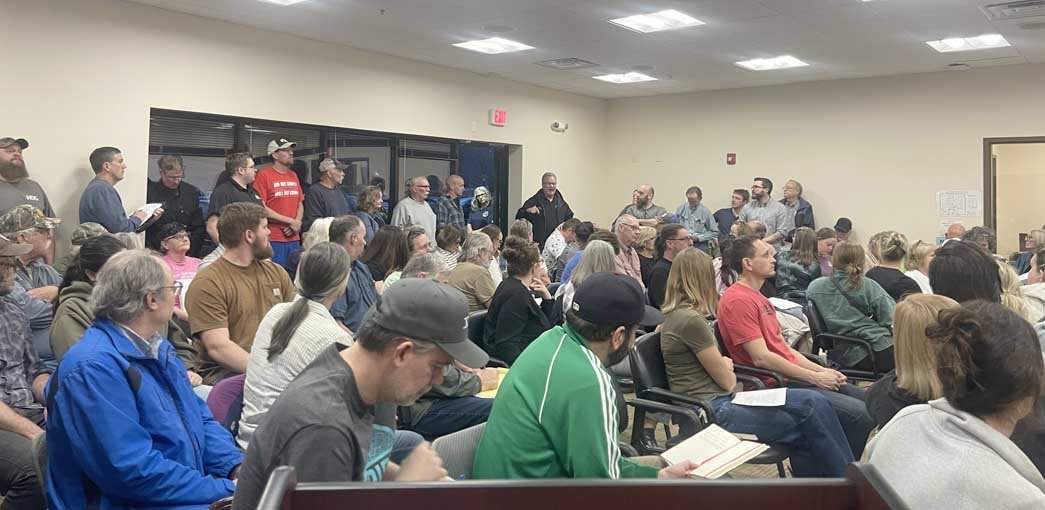
More than 100 people attended an April 14 public hearing on a proposed data center ordinance in Clayton County, offering suggested revisions and voicing concerns about potential impacts. The crowd filled the room and extended outside, with doors left open to accommodate the overflow.
Concerns raised by speakers included increased energy demand, high water use, noise and visual impacts, soil, groundwater and air pollution, heat output, loss of farmland and effects on natural resources and tourism.
The hearing was held by the county’s nine-member planning and zoning commission, which is appointed by the board of supervisors.
The commission reviews zoning matters and makes recommendations on ordinances that guide development across the county. If advanced, the ordinance would go before the board of supervisors, which must complete three readings before final approval.
Questions about long-term impacts were a recurring theme throughout the hearing. In a written comment submitted prior to the meeting, Bethany Duff asked, “While data centers are not inherently good or bad, are we prepared for their long-term impact? Clayton County is resource-rich, but we need to steward it carefully.”
Glenda Bodensteiner, who identified herself as a cancer survivor, shared concerns about the health of Clayton County residents, raising questions about the potential impact of electromagnetic frequencies on youth, older adults and individuals with medical devices such as pacemakers and insulin pumps.
In a later statement, Cheryl Drowns echoed those concerns, noting, “We’re number two in the nation for cancer. We’re the only state in the nation with rising rates of cancer. It’s already a concern.”
John Claycamp expressed concerns about environmental contamination, pointing to chemicals used in cooling systems, including PFAS, or “forever chemicals.” He said these substances “accumulate in the body and in the environment over time and have been linked to high rates of cancer—not just in humans, but animals, too,” and questioned how waste from those systems would be handled locally.
While the proposed ordinance requires closed-loop cooling systems—intended to reduce overall water use—some speakers questioned how those systems operate in practice. One individual with a technical background noted that periodic discharge and refilling are still required, despite being described as “closed loop.”
Kara McCartney, a Gunder native who now resides in Washington, D.C., shared her experience living near one of the largest concentrations of data centers in the country. She said “a single data center uses as much water as the entire city of Washington, D.C., every single day.”
McCartney also emphasized the importance of requiring data centers to cover infrastructure costs. “You absolutely need to make sure that data centers foot this bill and that it’s not passed on to consumers like it was for us,” she said. “Our electric bills have risen by 41% since 2023. It is not uncommon for a three- to four-bedroom house’s electric bills to be up to $900 a month.”
She described the impact on daily life, saying the constant noise from facilities has led some residents to consider leaving the area, with some even unable to sell their homes.
One local resident, who said she had been approached about a data center potentially locating on her property, described being told it would be “no worse than being next to a corn dryer,” adding, “Have you stood next to a corn dryer…for 24 hours, seven days a week?”
Concerns about the impact on natural resources and tourism were echoed by multiple speakers, who described the county’s landscape as central to both its identity and economy. One speaker noted that “the natural beauty and the recreation opportunities of this county are valued by both its residents and the tourists who spend their dollars here.”
Others emphasized the area’s appeal as both a destination and a place of refuge. “If you live in a city with much cement and noise, it is a welcome refuge to come to a beautiful place like Clayton County,” one resident said.
“When you leave those bigger cities…and you get back into Clayton County, you feel like you’re home,” another added.
Others were more direct about the potential visual impact, with one speaker describing data centers as “an ugly eyesore.”
Throughout the public comments, speakers pointed to several areas where the ordinance could be strengthened or clarified.
Tom Klingman, who submitted a written comment prior to the meeting, praised the commission’s work on what he called a “solid” ordinance, but identified four areas he encouraged them to address. His suggestions included requiring data centers to invest in local infrastructure, encouraging smaller, distributed facilities rather than a single large site, ensuring utility costs are not passed on to residents and revising restrictions on modular structures.
Other suggestions included more specific requirements for water use and pollution monitoring, including how closed-loop systems operate, how often discharge may occur and how wastewater would be tested and managed.
Some encouraged adding environmental site evaluations, including groundwater, sensitive habitat and long-term impacts, along with clearer expectations around decommissioning to ensure sites are properly restored if operations cease.
Speakers also raised concerns about the ordinance’s setback and parcel size requirements, saying those standards may be difficult to implement as written and should be revisited, along with clearer guidance on visibility.
There were also calls for stronger protections for residents, including requiring developer-funded infrastructure improvements and ensuring utility rate increases are not passed on to local customers.
Some suggested exploring community benefit agreements that would require developers to contribute directly to local infrastructure or community needs.
Expanding the ordinance’s noise section to address intermittent noise alongside continuous limits was another suggestion, as well as encouraging or requiring the use of local contractors during construction, noting the limited number of long-term jobs typically associated with data centers.
Overall, the feedback reflected a push for an ordinance that is clear, enforceable and able to address long-term impacts, including the potential for legal challenges.
In addressing how they wanted the county to proceed, some suggested keeping the current moratorium in place indefinitely, though moratoriums are temporary measures typically used to pause development while regulations are reviewed or created.
Others pushed for an outright ban on data centers, which was opposed by other speakers who expressed concern that a full ban could leave the county vulnerable if challenged in court.
Some in attendance called for a public vote on the issue, though zoning ordinances are not approved through referendum and are instead adopted by the board of supervisors through the standard ordinance process, which includes public hearings and multiple readings.
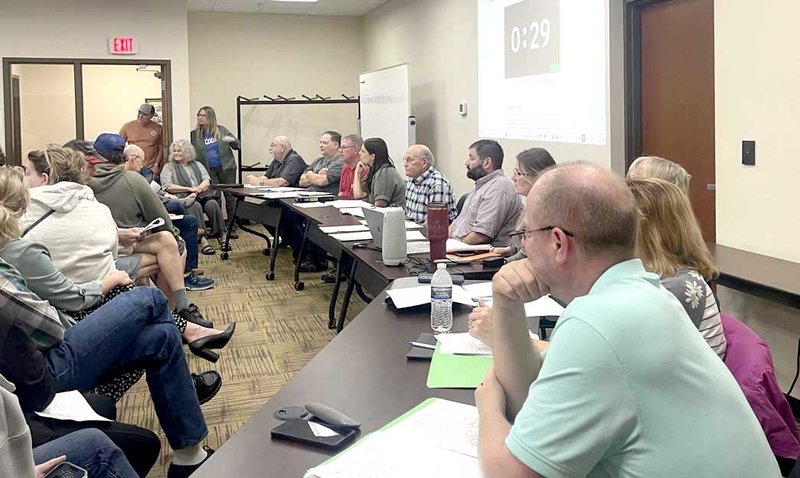
Ultimately, the Clayton County Planning and Zoning Commission voted unanimously to review and revise the draft ordinance, with several members noting they had received valuable input from the public and would take those comments into consideration moving forward.
Speaking after the meeting, commission chair Doug Puffett said the hearing was an important step in the process.
“We knew we were only one stage in the process,” Puffett said. “Until we hear from the public at a meeting like this, we don’t know what people have to say. A lot of the discussions we heard tonight are things we’ve talked about over the past five months, and I’m confident we’ll come to some sort of agreement.”
He said the commission will continue working through the feedback as they move forward.
“Ultimately, we want to do what’s best for Clayton County and its residents,” Puffett said, encouraging residents to continue sharing their comments as part of the process.
The planning and zoning commission will continue working on the ordinance at upcoming meetings and is expected to schedule another public hearing once a revised draft is ready. Agendas and meeting information are available on the county website.