By Audrey Posten
The default speed limit on many of the two-lane state and federal highways and rural paved roads in Iowa increased from 55 to 60 miles per hour on July 1. Most roads in Clayton County remain unchanged, however, pending a safety review.
When signing Senate File 378 into law on June 1, Iowa Gov. Kim Reynolds cited frequent requests from Iowans as the reason behind the speed limit change—the first in 52 years.
“They’re pretty excited that it’s going to be legal to drive what they’ve been driving,” she told reporters.
Clayton County Engineer Casey Stickfort acknowledged “there are many logistical benefits with the increased speed limit. However, our beautiful county has many horizontal and vertical curves due to its unique topography. In some cases, traveling at speeds greater than 55 mph is challenging or dangerous.”
That’s why the Clayton County Board of Supervisors passed a resolution on June 23 affirming that paved concrete and asphalt surfaced secondary roads with a 55 mph speed limit will remain so for now.
According to Stickfort, a brief list of traffic control devices that will need a comprehensive safety review include pavement markings for no passing and passing zones, horizontal curves that may need a speed advisory sign greater than 50 mph, stop ahead warning sign placements and upgraded speed limit signs.
“We have approximately 220 miles of concrete, asphalt and seal coat roads and are in the planning stagings of the safety review,” Stickfort said. “Timelines and costs are still being looked at.”
“My number one duty as a professional engineer is to hold paramount the safety, health and welfare of the public. With that said, there may be routes 60 mph speed may not be safe,” he added.
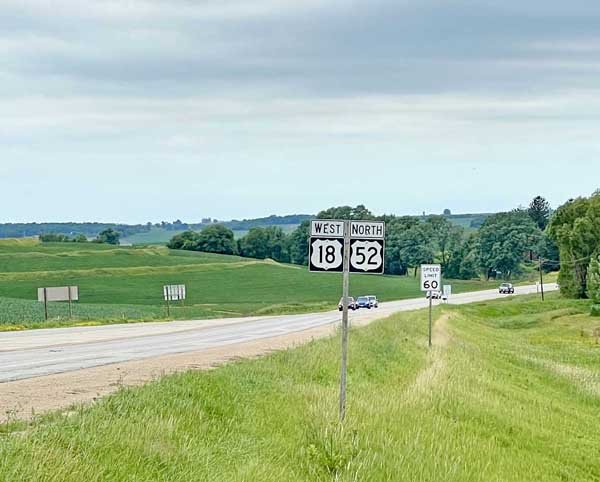
The Iowa Department of Transportation is also reviewing roadways in Clayton County under its purview. While speed limits on relevant portions of highways IA 128, IA 3, IA 56, US 18 and US 52 have been updated to 60 mph, the District 2 office said some portions of roadways will stay at 55 mph pending additional review. This includes IA 13 from Strawberry Point to IA 128, US 52 from Guttenberg to Garnavillo, US 52 from Luxemburg to Garnavillo and IA 76 from McGregor to US 18.
“I can’t speak to each individual route, but our typical reasons for maintaining a 55 mph speed limit over 60 mph are due to engineering and traffic criteria, such as curvature, traffic levels and terrain and vertical sight lines,” explained Daniel Yeh, director of government and community relations for the Iowa Department of Transportation. “On those roadways that have changed to 60 mph, we may return with other changes such as remarking of passing zones or installation of additional guardrail on curves.”
The DOT has temporarily replaced speed limit signs with an overlaying material before fully replacing the signs. Officials said the timeline to permanently replace each sign is unknown.
Data from the Legislative Services Agency said there are an estimated 1,794 55 mph speed limit signs under the jurisdiction of the DOT that will each cost an estimated $75 to overlay and an estimated $171 to be replaced. Under the jurisdiction of counties, there are an estimated 3,465 55 mph speed limit signs across the state that will cost an estimated $111 each to replace. Senate File 378 is estimated to have a one-time cost of $825,000.
No matter where they are driving, Yeh said the Iowa DOT advises motorists to always follow the posted speed limit.
“Even when the posted speed has increased to 60 mph, motorists should be aware of conditions and consider reducing speed at night and especially during rain or snow events. Motorists should also remember that it will take more distance to stop and they will have less time to react to slow moving vehicles such as farm equipment or wildlife crossing the roads,” he said.
Law enforcement are also urging motorists to obey posted speed limits and err on the side of caution.
Within the Mar-Mac Law Enforcement District, the default speed limit increase affects approximately one mile of U.S. Highway 18 within the city of Marquette. Mar-Mac officers also regularly patrol an additional two-mile stretch of U.S. Highway 18 to Eagle Drive while traveling to the north side of the city of McGregor. Because the change has only been in effect for a short time, Mar-Mac Police Chief Robert Millin said it is still too early to determine whether it has had a measurable impact on traffic safety or driver behavior.
“We will continue to monitor traffic trends over the coming months,” he said.
According to Millin, from July 1 through July 7, Mar-Mac officers issued two speeding citations and 23 traffic warnings. During the same period in 2025, officers issued two speeding citations and two traffic warnings. The majority of warnings issued this year were to drivers traveling between 11 and 15 mph over the posted speed limit, he said.
Mar-Mac Police also investigated one traffic crash during this year’s period, in which speed may have been a contributing factor, compared to no crashes during the same period in 2025.
“While these numbers are noteworthy, they represent only the first week following the speed limit change and are not sufficient to identify any long-term trends,” Millin said. “Regardless of the posted speed limit, motorists should remember that the speed limit is the maximum lawful speed under ideal conditions, not necessarily the safest speed for current conditions. Drivers should always adjust their speed for weather, traffic, visibility, roadway conditions and the presence of pedestrians or bicyclists. Increasing the speed limit by 5 mph also reduces the amount of time available to react to unexpected hazards and increases stopping distance, making attentive driving more important than ever.”
“We’ll continue to educate motorists and enforce traffic laws as needed to help keep our roadways safe,” he added.