The Urban Forestry Awards luncheon annually recognizes Iowa cities, college campuses and utilities that demonstrate dedication to the importance of trees in their respective communities.
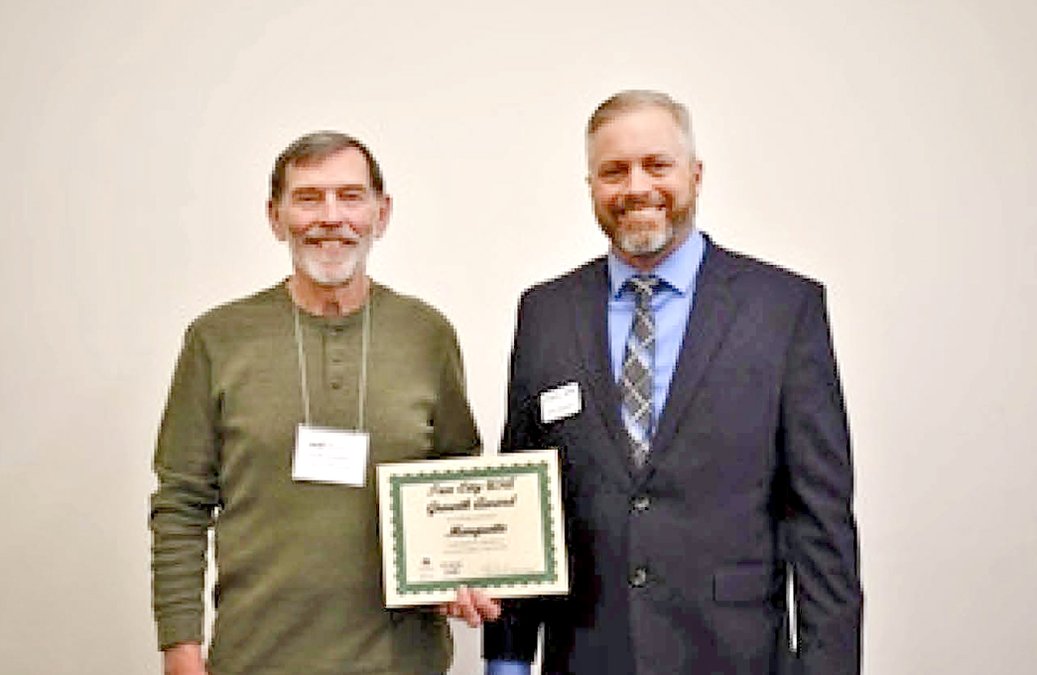
Awards were presented April 8, at the FFA Enrichment Center in Ankeny, on behalf of the Arbor Day Foundation and the Iowa Department of Natural Resources. The city of Marquette was presented with the Tree City USA Award for the 23rd year.
To qualify for the Tree City USA Award, a city must have either a city forester or an active city tree board, have a tree ordinance, spend at least $2 per capita annually for its community forestry program and have a tree planting and maintenance plan.
“And not only did we get Tree City USA certification, but we also got the Growth Award for the fifth straight year,” said Don Smalley, who heads up the Marquette Tree Board. “There are 71 Tree City USA cities in the state. We’re one of those. And there are only 21 cities that got the Growth Award. We’re brushing elbows with some pretty big communities.”
To qualify for the Tree City USA Growth Award, cities must provide education and public relations, partnerships, planning and management and tree planting and maintenance in their community.
Of the five years Marquette has received the Growth Award, Smalley attributed at least two years to how the tree board has managed the city’s Ohmer property. That includes trying to control invasives and doing timber stand improvements.
“Thinning out the forest and trying to open up the canopy so more light can come down. Then younger trees can grow and you get better succession,” Smalley explained.
Speaking at the April 14 Marquette City Council meeting, he said a program at the Urban Forestry Awards noted the benefits of woodlands in cities.
“So what we started to do a couple years ago with trying to manage that forest is important. The state says it’s important,” he said. “Our focus over the years has been trees in parks and trees along the streets, but at one of the council meetings earlier this year, you voted to include forestry in with what our tree board is doing. Just a technicality—we were doing it anyway. But we appreciate the support we’ve had in the past and hope that continues and even grows a bit. That Ohmer property is a big chunk of land, a lot of invasives, a lot of woods that need management.”
Smalley said those who use the trails on the property will notice some of the past year’s efforts. A contractor was hired to treat the invasive barberry, a thorny shrub, during the growing season. In the winter, undesirable trees and vines were thinned.
“He left the ones that are good for wildlife, the oaks and maples and ones that have some value,” said Smalley, but he acknowledged the area looks like a mess with the downed trees.
Similar to work at Pikes Peak State Park in recent years, he stressed it’s a management technique. The tree board is even considering creating an educational panel to explain what was done.
“We can put it up there so people who are up there and on the trails, when they see this mess of trees, there will be a little explanation. Hopefully we can do some education,” Smalley said. “It may be portable so it could be moved to other areas in the future.”
At last week’s council meeting, it was also noted that the city is exploring development of a firewood permit that, under supervision of the forest management group, would help clear the area.