By Audrey Posten
Phelps Farm, a greenhouse farm near Guttenberg, is adding new facilities to increase production and access to locally grown food thanks to a new, innovative financing tool launched by the Community Foundation of Greater Dubuque.
The Northeast Iowa Community Investment Fund is providing low-interest, reimbursable funding for projects that address some of the Dubuque region’s greatest needs, such as affordable housing, regenerative agriculture, environmental sustainability and community infrastructure like education and health care. The first round of funding granted a total of $1.2 million to five local projects, including Phelps Farm.
Nonprofit and for-profit organizations that have already secured a portion of financing for their project can apply for a low-interest loan of $100,000 to $500,000 from the Community Investment Fund to help fulfill financial needs.
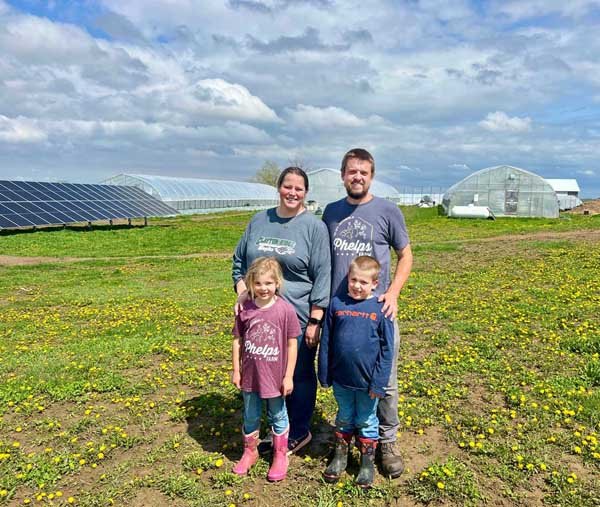
Phelps Farm offers locally grown produce year round through multiple greenhouses, along with honey, maple syrup, eggs and beef. Owners Andrew and Amy Phelps are excited to utilize funds for a solar project they say will make their business more sustainable and assure their vegetables are affordable.
“One thing we probably didn’t anticipate is the electrical usage, like running our walk in coolers and things like that. As we’ve grown and been running more of that electrical equipment heavy in the summers, the electrical bills got very expensive, which impacts our bottom line for being able to maintain our financial books, but also provide affordable food to local people,” Amy explained. “This was looking at the impact of maintaining our business operations sustainably, but also looking at the impact of the local communities and us being able to provide that food to the communities.”
In what Amy described as a “multi-tiered support system,” this will also help other farmers. Phelps Farm is growing its processing capabilities with the purchase of a large slicer/dicer machine, a flash freezer, a freeze dryer and a peeler.
“We’re in the middle of a construction project where we can set up for a licensed kitchen through the state and be able to sell wholesale, so other businesses could sell products that we make. Right now, we do it as a cottage food, so it’s a lot of freeze dried products. Once we have the license, we can do frozen, diced products,” Amy said. “We hope to work with other farmers in the region, so if they have an abundance of carrots, we’d be able to buy that from them and then process those into a usable frozen product. So this will support not just our farm, but other farmers who want to be able to resale their products and have their products sold locally too, without it going to waste.”
The Phelpses said this felt like a natural move for them, with consumer demand for more ready-to-use products.
Consumer demand for fresh, locally grown items has only grown since Phelps Farm began in 2019 on part of Amy’s family farm.
“We started in 2019, and really started growing in about 2020,” Andrew recalled.
He has an IT background, and his job at John Deere was being outsourced at the time. So he started farming.
“It wasn’t until 2021 that I think we went to our first farmers markets in Guttenberg. In 2022, we went to Guttenberg and Dubuque, and we’ve been doing a market in both towns since,” said Amy. “Guttenberg, we have a storefront set up on Saturday mornings. And then Dubuque, we do a year-round summer market and then their winter market at Kennedy Mall.”
Phelps Farm also has a community supported agriculture (CSA) program, so consumers can enjoy fresh, local food all season long
“We do spring, summer and fall, and then we do a winter membership just for past CSA members,” Andrew said. “We just started our spring one.”
Phelps Farm focuses on regenerative, organic‑focused farming. Produce is largely raised in greenhouses, or growing tunnels, some of which are now heated year-round. All is grown in the ground, and crops are rotated.
“For each tunnel, we’ve had to move a lot of earth to make them work. We’ve had to make waterways and kind of level spots for the greenhouses. And we haul compost in,” Andrew said. “Seed is all organic, non-GMO.”
Produce includes everything from strawberries, tomatoes, peppers, kohlrabi, onions, cucumbers, celery and radishes to spinach, lettuce, kale, cabbage, peas, bok choy, sage, rosemary, basil, ginger and turmeric.
According to Andrew, greenhouses extend the growing season—even in those not heated year-round. It also improves crop quality and yields.
“You have better control over the wind and watering and pests and stuff, too. It’s definitely a beneficial thing,” he said. “So most of what we grow now is indoors, under structure.”
The newer growing tunnels are automated, meaning Andrew can use his phone to open and close them.
“If I’m not here, and there’s a storm coming, I can close everything up remotely. Or if it gets too hot, I get a call. Or in the winter, if it gets too cold, it calls my phone,” he shared.
Although Phelps Farm has some honeybee colonies that provide honey, Andrew and Amy have found the honeybees reluctant to enter the growing tunnels when other food is available outside. They’ve brought in bumblebees to pollinate the vegetable crops instead.
“That green and white box down there is for the bumblebees,” Andrew said, pointing to their home. “They come out and pollinate our flowers for us, like the cucumbers and tomatoes. They mostly stay in here, and at night they go back to their little box.”
Phelps Farm does a lot of intercropping—growing two or more crops in the same space.
“Like this row here with tomatoes, we have kohlrabi growing next to them. As the tomatoes are getting bigger now, the kohlrabi will start coming out,” Amy said. “Here we have lettuce. This lettuce will come out soon, and then we can roll out the rest of the landscape fabric to weed barrier and cover the soil for the summer. These onions will all come out here in the next probably month or so. By that time, the cucumbers will be bigger.”
“We do a lot of that just because we can do twice as many crops in one space while we wait for those bigger crops to kind of size up,” she continued.
All of this, paired with the new upgrades, has the Phelpses moving “into more of what we envisioned when we started,” noted Amy.
She and Andrew are excited to do it in Clayton County, where their children, Ayden and Allie, take an active role in the operation.
“They’re always planting, growing things, taking care of things. They see what we do and they repeat what we do,” Amy said. “In the summers, they’re off school, and by that time we have an abundance of stuff. They’ll come popping out of a tunnel just eating a cucumber, eating a bell pepper or cherry tomatoes.”
The Phelpses want others to have that same access.
“I think there’s a high demand that people want fresh stuff,” Amy said. “A lot of people have their own gardens, but we’re finding it more so in the off season. So we’re just continuously cycling and trying to keep the demand filled for what people are looking for. I think that is important. And now that we have more indoor growing space, it makes it more feasible to do that.”