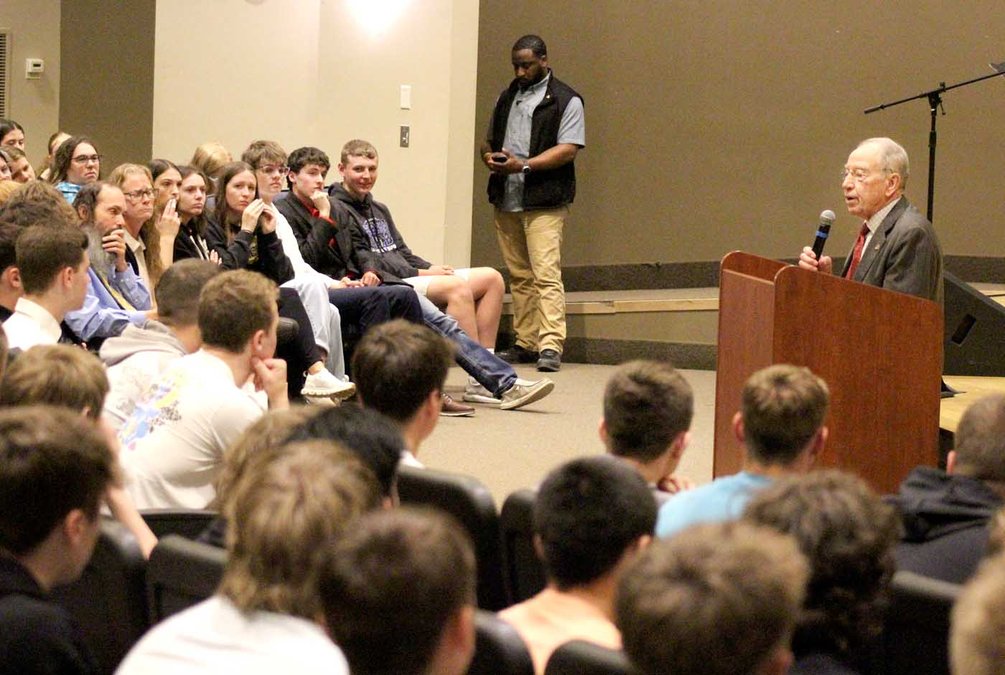
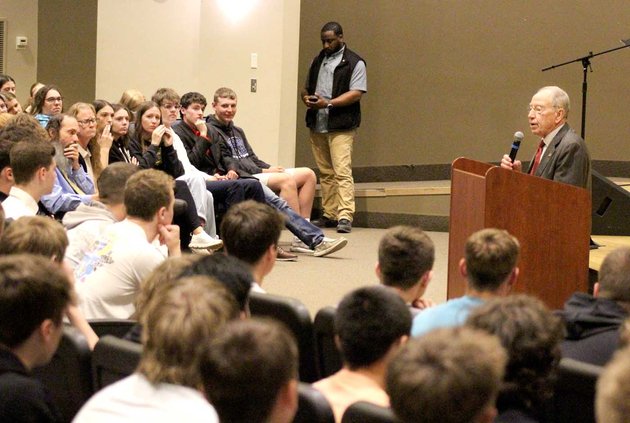
U.S. Senator Charles Grassley visited MFL MarMac on May 7, as part of his annual 99-county tour around Iowa. The senator, who previously visited the school in 2014, spoke before the whole high school student body, answering questions posed by social studies teacher Adam Simon but developed by students. Read the full Q&A here.
Q: Is Congress more or less productive today than when you started?
A: A lot less. And it's probably because of the time that 100 senators meet at one time, because you can't solve the problems, I can't solve the problems here by myself. I have to be meeting the 99 other senators. The number of weeks we're in session hasn't changed a whole lot. That'd probably be 40 to 42 weeks out of the year. This is one of these weeks we're not in session, and that's why I'm with you. But when I first went to the United States Senate, we'd start at 10 a.m. on Monday and probably go until four or five o'clock on Friday. Today, the Senate opens at 3 on Monday. Not too much business, maybe a vote or two, on Monday. Tuesday and Wednesday is a full day, but maybe by mid-afternoon Thursday, the Senate is done. Now, just in case that sounds like there's not much work being done, I'd say that's true as far as you can't solve this country's problems if you're only meeting three-plus days a week like we used to do. But if you're an individual senator, by yourself, like I am right now in Iowa, or anything else that the other 99 senators are doing, there's plenty of work if they want to work seven days a week. Now, I don’t claim to work seven days a week, but when you're an individual senator, there's plenty of things to do when you aren’t in session. I'm doing one of those right now, trying to keep in touch with Iowans so I can better represent them, knowing what's on your minds. I got to go around, and with my email, that's how you keep in touch with people.
But let me emphasize: the problems of this country are so great, we should still be meeting five days a week. Now, occasionally, like three weeks ago, we were in session on a Friday, Saturday and Sunday and finished on a Monday, but that only happens a couple times a year. And it's something that's a real emergency that needs to get done. But we ought to be meeting five days a week.
Q: If you could change one thing for schools in Iowa, what would it be?
A: I think I've already done it. Now, the teachers who’ve been teaching here a while, you know what I'm talking about when I talk about No Child Left Behind. But the younger teachers have never been in that environment. So I think the one thing I changed for schools, and it was undoing something that I voted for to begin with. No Child Left Behind was an attempt by the federal government to make policy out of Washington, D.C. that would treat schools in Iowa, basically a rural state, the same as New York City. If it works for Iowa, it doesn't work for New York City. If it worked for New York City, it wouldn't work for Iowa. But George Bush, as a Republican, and Senator Ted Kennedy, chairman of the education committee, thought that we ought to have more policy made in Washington, because we were putting tens of billions of dollars into education and the tests were not showing a lot of progress. Well, doesn't that make a lot of sense? So you go through that, you pass No Child Left Behind, and after about 10 years, you decide it hasn't done what it was supposed to accomplish, and it was doing more harm than good. Then, maybe two or three years later, so I'm talking about maybe 12 or 13 years, we finally repealed it. And I think that's the best thing I can do for education.
Now, if you wonder why making education policy in Washington might be bad, first of all, it's not a constitutional responsibility to the federal government. And about the way you get your foot in the door is through federal dollars. But our country is so geographically vast and so heterogeneous in our population that it's better to leave it to the states almost wholly for education policy, so that Iowa can do what's right for Iowa and New York can do what's right for New York.
Q: What efforts do you make in the U.S. Senate to support small-town businesses here in Iowa?
A: Most of it would come through either what you call regulatory policy or tax policy. If there's some other ways that maybe you could think of that's more than just those two, I'd be glad to comment on it. But I think in terms of inequality between corporations and small businesses that are mostly not corporations, an example would be in the tax bill that we recently passed. We reduced the corporate rate from 35 down to 21, because the United States had the highest corporate rate in the world and we were very uncompetitive. So when you do that, then you make it more unequal with small business, which usually files personal income tax. So that rate would still be 35, to bring some equality to what we have, what we call a 20% above the line tax deduction for small businesses and farms, to try to equalize with corporations. It's not a complete equality, but it's really very beneficial to small businesses.
And then when I speak about regulation, every regulation has to come from some law that Congress passed. But once Congress passed the laws, sometimes in those laws, we delegate authority to the executive branch to write regulations. And I'm telling you, we are not careful enough when we delegate authority to write regulations, and you get a lot of red tape and you get a lot of over regulation, and it just is a terrible burden for small business. Now, Congress creates that problem. You can always correct that problem by rewriting the legislation, but in most cases, to help small business, what you do is you put pressure on the president to reduce regulations or not to have. In the case of President Trump, he has, I guess you call it, an unwritten rule, but it's being followed closely, that for every new regulation you write, you do away with three regulations. And that's perfectly appropriate, because maybe some regulation was written 40 years ago and was not applicable today, so you need to have the review of those regulations all the time to know are they accomplishing what they were meant to accomplish when they were first done. But I think taxes and deregulation is the best thing we can do for a small business.
Q: In front of us, we have many, many high school seniors and they're going to graduate. What are we going to do to keep young people in our state so they don't go elsewhere? There seems to be a trend where a lot of educated people are leaving our state and going to different states for jobs. What can we do to keep young people in our state?
A: One thing that I promoted, and I'm not the author of it, but I'm a backer of it, and I've been a co-sponsor of the bill. A lot of people start college and about a third of them drop out at the end of the first year. So they get a lot of debt and don't have anything to show for it. When it comes to the Pell Grant then, to get people thinking about what they want to do for their life, I’m not going to discourage anybody from getting degrees at community colleges or four-year colleges. You should do that if that's what you want to do. But for a lot of people, looking at job opportunities, there's a lot of non-degree jobs that you can get that pay more than maybe if you got a BA degree. So let's say maybe that could be a plumber, a carpenter or this or that. So we made the Pell Grant available to non-degree people because, presently, if you don't get a two-year degree or a four-year degree, you can't get a Pell Grant. So if you want to be a plumber, you can get a Pell Grant now, and we would think that those types of jobs would keep young people in Iowa.
Now, kind of not on a facetious note, but it may sound facetious, but I meant to be a thoughtful approach, there are some people that just have their mind made up they're gonna see where the grass is greener someplace else. I've been dealing with this issue of your question for decades, and we always talk about young people leaving Iowa, but you never hear about the people that when they marry and have kids, they want to come back to Iowa to raise their kids here. There's some things about Iowa that you don't appreciate when you're 18 years old that you're gonna appreciate when you're 30 years old. So I guess my last answer to your question would be, even at age 17 or 18, you ought to think about Iowa and start comparing it to other places to live and work. Just come to Washington, D.C. and fight traffic going to work every day is just one example.
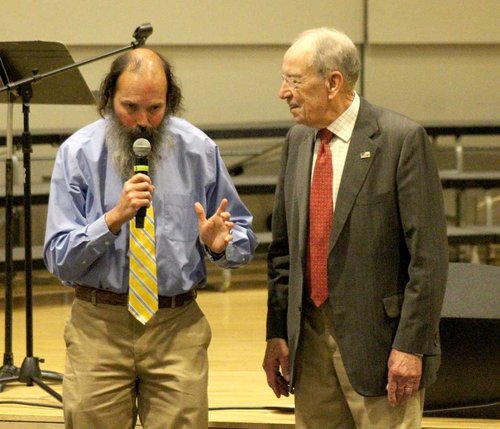
Q: Has your view on politics, the U.S. or Iowa changed since you've become a senator?
A: As far as the job is concerned itself, and the time that the senator meets and doesn't meet—like three or three and a half days a week, or something like that, compared to five, that's one. The other one is the increase in partisanship. But when I always talk about that, I always have to say it's an issue that comes up quite often from Iowans. I always add that it's not as bad as you think. It's not good, but it's not as bad as you think. And this is because on television and newspapers and radio and podcasts and social media, all you ever hear about is Republicans and Democrats fighting. Or even within the Republican Party today, particularly in the House of Representatives, big differences. You get the idea that Republicans don't talk to Democrats and vice versa. And that's not right. Particularly in the United States Senate, where you have to have 60 votes to stop debate, to get to finality on a bill, and you got 53 Republicans and 47 Democrats, if you don't have some cooperation, nothing’s going to get done. So there is an increase in partisanship, but it surely isn't as bad as what you think.
Since I'm a member of Congress and I don't expect you to believe what I say, I'm gonna give you a citation that I think I have a pretty good record of bipartisanship. So you go to the Georgetown University website, click on Senator Lugar Center, and they do an annual survey of bipartisanship in the United States Senate. Out of 100 senators, you always find me in the top 12, sometimes as good as the top five, of working in a bipartisan way in the Congress of the United States.
Q: Who was the favorite congressman or favorite senator that you've worked with through your time?
A: It’s hard for me to come up with that because there's people you might disagree with 100%, but they may be the most likable people that you're serving with. The Senator for Vermont is an example of that, the only socialist member of the United States Senate. He doesn't even call himself a Democrat. He caucuses with the Democrats, but calls himself an Independent. But when he ran as mayor of the capital city of Vermont, he ran as a socialist. So, obviously, he and I don't agree much on policy, but to just give you an example of the camaraderie you have in the United States Senate, he and I don't meet face to face to talk very often because we're on the same committees. But let's say I'm coming in to vote and he's going out to vote on the center floor, sometimes he says to me, Chuck, keep healthy cause I don't want to be the oldest one in the United States. So that's the fun you get.
To answer your question, Senator Dole, now deceased. He was a floor leader when I went to the United States Senate, and he was coming from an agricultural state. He was a member of the agriculture committee. I first got on the finance committee and he was chairman of the committee. He helped me an awful lot as a freshman senator. Then he resigned from the Senate in 1996 when he was running for president. Obviously, he didn't get elected president, and then he was a private citizen and an advocate for certain causes after he left. He was in bad health the last few years, but maybe a month before he was passing away, I went to his wife and said, “I'd like to see Senator Dole.” He was kind of in a hospital bed in his own apartment in Washington, D.C. If you would close your eyes and listen to him talk with his strong voice, and with his knowledge of what was going on in the Senate, and even though he'd been out of the Senate for 25 years, he still knew what was going on in the Senate. If you close your eyes, you wouldn't know that he was the weak person that he was.
Q: If you had to reflect on your political career, what would be your favorite moment? Or what do you feel was your biggest accomplishment?
A: Two. One, it's kind of become controversial the last five years, but I'm the Father of the Wind Energy Tax Credit, where we get 60% of our electricity from wind. I think that that would be one.
The other one was, it wasn't a bill that I thought of, because it was an issue for six years before I finally got it passed. But it was kind of a collegial effort that was bipartisan to get drug support for senior citizens through Medicare. Because, you know, when Medicare started in 1966, prescription drugs, it was probably only about 1% of the cost of medicine, and then it got to be maybe 15% or more today. So in 2000, we started working on expanding Medicare to cover prescriptive drugs. And that's when you hear the word part D of Medicare. That's what I lend the efforts to do.
Q: Can you discuss the current funding systems of public schools versus private schools in Iowa? But you kind of discussed that already, because you said that should be left to the states, obviously, and not the federal government.
A: There is a little bit of federal government involvement now as a result of the recent tax bill, where any family can get a tax credit, I think, of $1,700 that could be used for charter schools, home schooling, private schools. But we are not forcing the states to participate in it. The governors make those decisions, and I guess maybe about a dozen governors are saying they're not in favor of it for their state. It kind of gives people an opportunity to look, and parents to look at, how their kids are getting along in whatever school they're in. Then you use that for that. You could even use it for people that are in a public school, and maybe there's some service that a local district doesn't have, that parents could use the money to supplement that as well. If you kind of wonder where the idea of alternatives to public education comes from, I think Washington, D.C. would be a good example. It didn't start with tax money. It started with some philanthropist that was studying the bad education that kids in Washington, D.C. were getting, when about 50% of the people graduated without being able to read. He said, I’ve got to do something about that, so I'm going to finance a thousand kids for alternative education, and 10,000 people applied for it. Just to show you the discontent of the Washington school system. That's kind of where that thing grew, but that goes back 20 years. It has become a bigger issue as time goes on.
Q: What is one word or phrase you would say to sum up the current state of the United States of America?
A: Well, I can't do it in one word or one phrase. I could do it in a concept. Maybe one word that would describe it, but I want to go way beyond one word. America is an exceptional nation. Now, that irritates a lot of people in America when we say that, because we think we're better than other people in the rest of the world. That isn't what we mean. America is an exceptional nation based upon our founding and our history and where we've gone over the last 400 years. We started this country because the people that were in the 13 colonies were sick and tired of being denied freedoms that people in England had, and they were just as English as people in England. But they were denied those rights. So the Revolutionary War and the Declaration of Independence. We declared in that Declaration of Independence that we’re endowed by our creator with certain inalienable rights—among them life, liberty and the pursuit of happiness. So we get our rights from God, not from the government. So then what's exceptional about us? We set up a constitution to make sure that one person, like George III, who was denying the rights to the people on this side of the ocean, that they weren't going to have one person that could do that. So we have an executive, legislative and judicial branch of government to make sure that the power isn’t all in one place. The constitution wasn't written to give you your rights, even though we have a Bill of Rights, because if the government gives you those rights, they can take it away from you. And we're the only country on the face of this earth, throughout the 6,000 years of human kindness, humanity, that has that sort. And that's what's exceptional about it. So whatever you want to do as an individual, you can do. You can make out whatever you want to make out of yourself. We don't have the government dictating those things to you. It permeates our political system, our social system and our economic system. So the word exceptional is what I want to give you as an answer.
Q: A lot of the kids wrote this down, which is kind of crazy to think about. Many of these kids follow you on your social media, and they want to know what the obsession is with Dairy Queen, and what is your go-to Dairy Queen get if you go to Dairy Queen?
A: I guess the Snickers Blizzards.