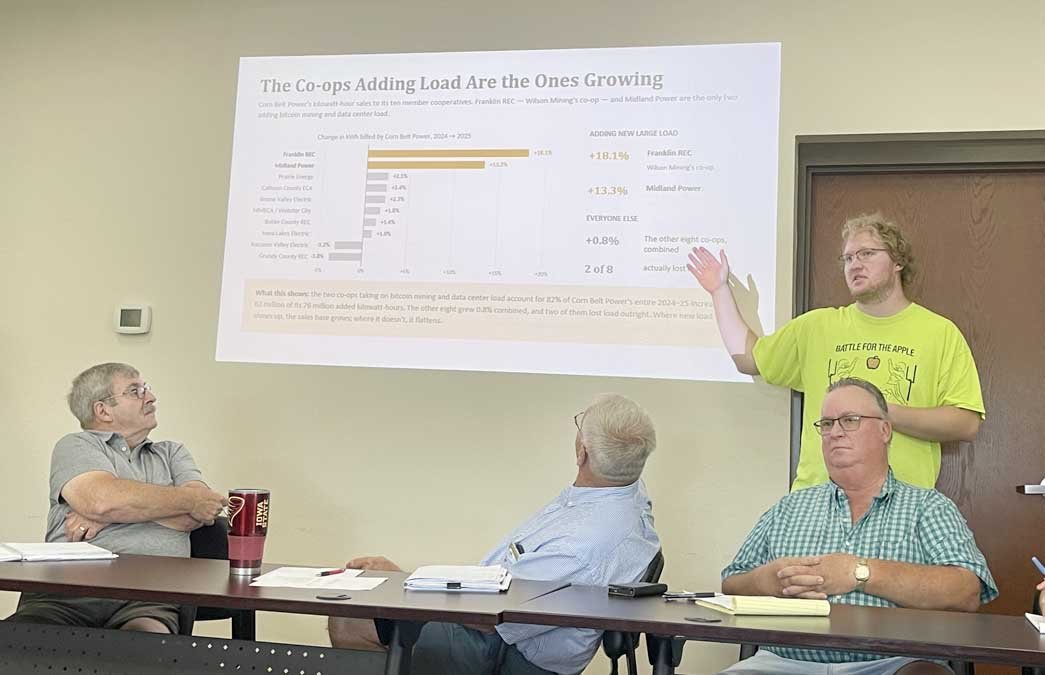
Nearly three dozen community members attended the Clayton County Board of Supervisors meeting July 21, to hear a presentation from representatives of Allamakee-Clayton Electric Cooperative (ACEC) and Wilson Mining LLC about potential data center development in the county.
Prior to the presentation, Supervisor Doug Reimer addressed a recent Facebook post claiming he intended to sell family farmland to a data center developer. Reimer said there was no truth to the claim, noting his family has owned the land for generations and he has no intention of selling it.
He also emphasized the board has not made any decisions regarding data centers.
“We have not voted on this. All we’ve ever said in this room is we need more information. And that’s what we’re doing today,” Reimer said.
Representing ACEC were Executive Vice President and General Manager Hollee McCormick and Member Services Manager Ryan Wagner. Eric Wilson, who owns Wilson Mining LLC with his brother, Steven, discussed the company’s existing operations and a potential future project in Clayton County.
Wilson Mining is not a traditional mining company like those in northeast Iowa that extract or process aggregate. Instead, the company operates bitcoin mining and hosting facilities.
Wilson said he and his brother originally planned to farm their family’s land but entered the bitcoin mining industry after realizing they could not afford the equipment needed to get started.
“We were going to farm, and we couldn’t afford the tractor, so we had to find something else to do,” Wilson said. “This is what we stumbled upon.”
The company’s primary bitcoin mining facility is located on the brothers’ property in Franklin County. Wilson Mining also operates a second facility in Franklin County for a customer based in California, while a third privately owned facility in the county is supplied with electricity by Franklin REC and Dairyland Power Cooperative.
Wilson said the proposed Clayton County project would be much smaller than the large-scale data centers often shown in national news coverage. The proposal would consist of a single 1.6-megawatt shipping container occupying roughly 1,500 square feet.
“That’s what we’re talking about—1,500 square feet,” Wilson said. “Not a huge amount of space; it’s pretty power dense.”
He added that the project would be limited by the electrical capacity available at the selected substation.
“That’s the max,” Wilson said. “I’d love to [expand], but they don’t have the capacity for it.”
Wilson also said the proposed facility would not include backup generators and would simply shut down during power outages.
ACEC representatives explained their role in evaluating proposals such as Wilson’s.
“As a utility, we have an obligation to serve,” McCormick said. “If somebody knocks on our door and says they’d like to locate within our system, we have an obligation to study that.”
McCormick and Wagner added they have received inquiries from businesses potentially interested in locating within their service area.
McCormick acknowledged many residents have concerns about data centers and said the cooperative understands those concerns.
“We understand people’s hesitations,” she said. “We understand the information that’s out there is not always painting a great picture.”
Wagner explained that while ACEC has the capacity to serve Wilson Mining’s proposed facility, it could not be located just anywhere.
The cooperative operates 16 substations across its service territory, including seven in Clayton County, and any facility would need to be located near an existing substation. Later in the meeting, Wilson identified the Postville substation as his preferred location because of its available electrical capacity.
Wagner also emphasized the proposal is not comparable to the hyperscale data centers being developed elsewhere in the country.
“The most we can do is what I would consider a very small data center load,” Wagner said.
He added that facilities the size of those operated by companies such as Google, Meta and Microsoft would not be possible on ACEC’s electrical system.
Electric rates were another topic discussed throughout the meeting.
McCormick and Wagner said they do not expect Wilson Mining’s operation to increase electric costs for cooperative members. Instead, they said the facility would primarily consume electricity during off-peak hours when demand is low and electricity is less expensive. During periods of peak demand, Wilson said the company’s operations shut down because electricity becomes too costly.
The presenters also explained that any infrastructure upgrades needed to serve a new facility would be paid for by the developer rather than existing cooperative members.
Wilson described how that process worked when his Franklin County facility was constructed.
“We walked in with a check and said, ‘Here you go. Please build it for us.’”
Wagner added that studies conducted by ACEC and Dairyland Power Cooperative would determine whether the electrical system could reliably serve any proposed project before construction could move forward.
Community members also questioned the proposal’s economic impact in Clayton County in terms of new jobs or increased property tax revenue.
Wilson acknowledged the project would not create permanent jobs beyond his own role maintaining and operating the facility. However, he said it would generate sales tax on electricity purchases. It was unclear if there would be any additional property tax revenue based on the type of structure he would use. He also shared he would lease the land he is looking at developing on, not purchase it.
Water use and quality impacts also drew questions from residents.
Wilson said the proposed facility would operate using a closed-loop cooling system containing coolant rather than water.
“We don’t use any water,” Wilson said. He explained the coolant is recycled within the system and replaced approximately every five years in a process similar to servicing agricultural equipment.
Residents also asked about the future of the facility should bitcoin mining become obsolete. Wilson said the equipment could be converted to support other computing workloads, including artificial intelligence applications.
Wilson also commented on the county’s draft data center ordinance, arguing the proposed nighttime noise limits would effectively prevent his project from locating in Clayton County. During his presentation, he displayed a sound meter to illustrate that the discussion itself exceeded the ordinance’s proposed decibel limit.
Other questions from community members focused on potential long-term health impacts, effects on livestock and wildlife, property values, infrasound and preserving the character of northeast Iowa.
One resident urged county officials to consider more than the financial aspects of the proposal.
“This presentation has been about dollar cost, but you cannot buy some of the things that we have here.”
Reimer closed the discussion by reiterating that the board had not taken a position on data center development.
“We’re all studying together,” Reimer said. “That’s what we’re doing. That’s our job.”
The Clayton County Planning and Zoning Commission began work on a data center ordinance in December. After monthly workshops, the commission held a public hearing on its original restrictive draft ordinance in April. After the public’s comments, they returned to workshops in May and June, to develop a prohibitive draft ordinance as well.
At its July meeting, the commission held a second public hearing on both ordinances before voting 5-3 to return to additional workshops for further revision. Their next meeting and workshop on the proposed ordinance is scheduled for Tuesday, Aug. 11 at 7 p.m., at the County County Office Building at 600 Gunder Road in Elkader.
Once the commission develops a draft ordinance it is satisfied with, it will hold another public hearing before forwarding its recommendation to the Board of Supervisors. The supervisors will then consider the ordinance through three readings before taking final action or may return it to the commission with suggested revisions.
The county’s current moratorium on new data center applications is set to expire Dec. 31, although it may be extended by the Board of Supervisors.