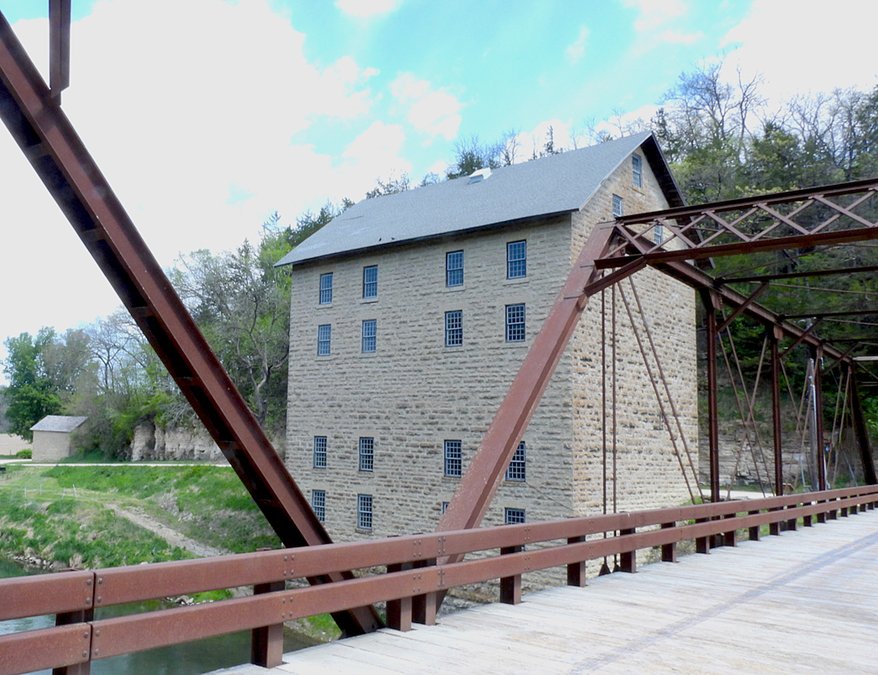
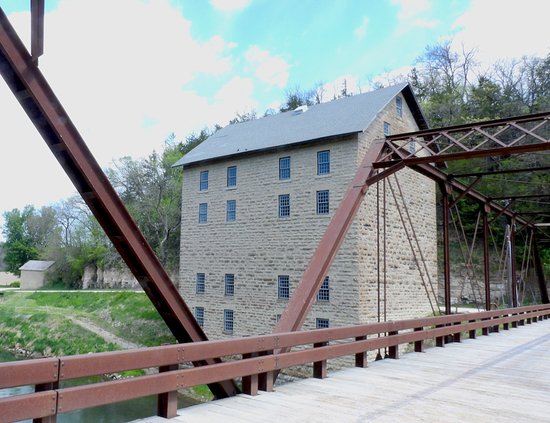
Clayton County’s iconic Motor Mill, the 156-year-old limestone structure looming almost 90 feet above the Turkey River five miles downstream from Elkader, will again attract tourists from afar when it opens for the season on Memorial Day weekend. But this year’s visitors will be able to learn more about how wheat was processed into flour a century and a half ago, thanks to models of milling equipment built by a Wisconsin craftsman and historian.
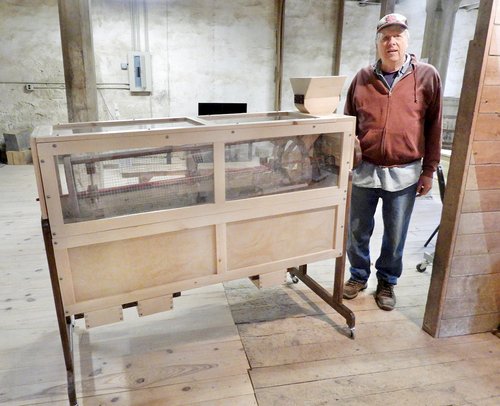
Joe Miller, of Bloomington, Wis., built a working model of a bolter, which is a machine used to separate and purify the grindings after wheat berries are cut and crushed by millstones. The model includes a crank so visitors can spin a sloping cylinder covered with four sizes of screen wire. When a mixture of different sizes of simulated grain flows down the cylinder, the smallest settle out first, and the largest go all the way through.
It’s the same principle as in a traditional flour mill, with fine flour collected first, followed by “middlings” and “shorts,” with the coarse “bran” dropping out the end.
Although Motor Mill’s original bolters and other milling equipment were removed when the Klink family acquired the mill in 1903, the mill building now houses several old, non-working bolters donated by Pickwick Mill in Minnesota. Miller’s model will make it easier for visitors to visualize how those mysterious-looking machines worked.
Kids especially will enjoy another working model built by Miller in 2025. A hand-cranked bucket elevator shows how grain and flour was moved throughout the mill by a complex of small buckets or cups attached to a continuous belt that ran on pulleys.
Many of the younger visitors also may be eager to trek all the way to the top of the six-story mill, where they can get a downstream view of the former Motor townsite, or an upstream panorama of the Turkey River valley. Other mill floors include interpretive panels describing the history of the indigenous people who first lived in the region, as well as the later transition to agriculture and the short-lived operation of a mill that did not fulfill its developers’ dreams.
One of the most popular exhibits is a unique, hand-made wooden turbine, which was one of four such devices that powered Motor Mill when it operated from 1869 to 1883. This turbine, along with parts of another, was uncovered when decades of sediment were removed from the mill basement in 2020, thanks to a donation of time and equipment by C. J. Moyna and Sons of Elkader. Two other turbines remain buried in the basement.
The Motor Mill founders—John Thompson, James Crosby and J. P. Dickinson—apparently built the turbine when they couldn’t afford to buy cast iron turbines. The oak turbine, which had been preserved under the mud and water, was shipped to the Maryland Archaeological Conservation Lab to undergo a year-long chemical treatment to prevent its deterioration after being exposed to air. It is now on display on the first floor of the mill in a protective plastic case.
Most Mill visitors also are fascinated by the eight massive stone pillars in the basement, which were made more visible by the removal of the silt six years ago. Ironically, removing the silt also revealed the need to stabilize the fractured limestone bedrock at the base of a couple of the pillars. That work was begun in 2025, and the Clayton County Conservation Board is consulting with engineers to determine how much further work is needed.
Although the Conservation Board acquired the mill and four associated buildings in 1983, the site remained mostly undeveloped until 2003, when the Motor Mill Foundation was formed. Volunteers began replacing flooring and floor joists in the mill, and contractors were hired to put on a new roof and replace a few aging post and beams.
Chuck Morine, one of the original Motor Mill Foundation Board members, recently was honored by the board for his decades of work. Fellow volunteers built a small, rustic workshop on the second floor of the mill to store historic artifacts, holiday lights and other items away from visitor traffic.
Although much of the focus at the Motor Mill Historic Site is on the Mill itself, the Motor Mill Inn, which was restored and opened for rental in 2023, has been increasing in popularity. The upper two floors of the inn are available for overnight guests or small meetings or conferences. The inn is air conditioned and includes a kitchen and laundry facilities. It sleeps up to 12 people.
The lower floor of the Inn serves as a visitor center. It includes a gift shop and historic artwork. There also is a large 3-D model of the Turkey River Valley to demonstrate the Driftless Area geology that made the site ideal to construct a water-powered mill.
The nearby stable also has been renovated and is available to rent as a gathering space for concerts or receptions. To reserve either the inn or the stable, visit www.mycountyparks.com
Motor Mill will be open for guided tours from noon to 5 p.m. on Saturdays and Sundays, beginning May 23. The Motor Inn visitor center also will be open daily, 10 a.m. to 5 p.m., with the option for mill tours available upon request.