By Audrey Posten
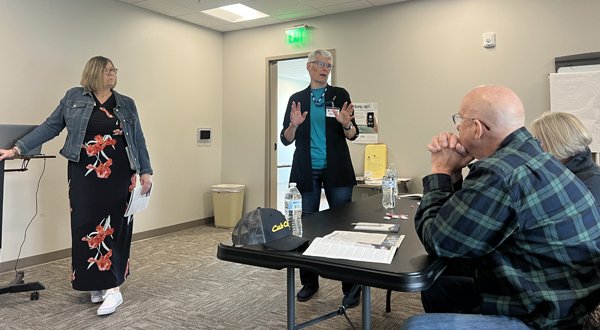
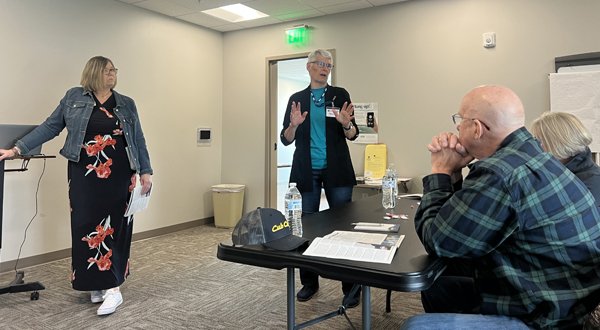
Iowa Fraud Fighters programs sponsored by the Iowa Department of Insurance and Financial Services are helping people learn about, prevent and protect themselves from scams. One event was held in Guttenberg this spring, and another is planned for Tuesday, July 7, beginning at 5:30 p.m, at the Guttenberg Public Library.
Lynn Jones, the Northeast Iowa RSVP coordinator for Clayton and northern Fayette counties, led the springtime program, which also included other local resources: Nancy McClellan, an RSVP volunteer with a tech background; Kim Davis, a SHIIP counselor who works with people on Medicare; Kari Harbaugh from the Family Resource Center; Darcy Cline from Peoples State Bank; and Guttenberg Police Chief Derek Chambers.
“We’re here to put a local face on the problem. It’s not something that’s way out there. It’s here,” McClellan stressed.
And it can affect a range of people, noted Jones.
“Scammers are preying on your ability to trust some of their tactics, and they do their homework. In our economic times, it doesn't just have to be people who are 60 years old or in retirement. They will get the single mothers. They'll get the college students. The problem is it's so underreported because people always say ‘It'll never happen to me,’” she said.
Criminals use a variety of persuasion tactics to convince people of an untruth in order to steal their money or personal information.
“Fear and intimidation is the big one that we hear the most,” said chief Chambers. “They’re going to try and scare you into giving them that money, giving them that access, whether it's the computer or the bank cards or something like that.”
“I would agree with fear and intimidation, but I would also add loneliness and relationships to that,” Cline said. “People are looking to be with somebody, and sometimes they go six, seven, eight months talking to somebody, and then [the scammer] asks for the money. There's an investment scam right there. They're investing time in you so they can get the big payout.”
Peoples State Bank also sees instances where targets believe they are talking to credible sources like a government agency, bank or business.
“They think they're talking to an authority, and then it's going to the fear and intimidation and sense of urgency,” Cline said.
“If it's urgent,” added McClellan, “it's more than likely a scam. Hopefully you have a friend, a neighbor, a relative you can ask about it. If it’s a legitimate bill to pay, you should have a paper invoice. You should be able to talk to that business and find out what you're paying for and that you receive the services you're paying for.”
Investment scams are one of the most prevalent fraud threats. These include Ponzi or pyramid schemes, promissory notes, oil and gas drilling programs, gold and precious metals, free dinner seminars, self-directed IRA fraud, high-yield investment products and cryptocurrency.
Cryptocurrency is a digital or virtual currency not regulated by a bank or financial institution and may be used for purchases or investments. Many investment opportunities are promoted through social media by individuals claiming to be experts. Often, legitimate cryptocurrency purchases are made by victims and unknowingly transferred to the scammers.
“For cryptocurrency, you have to have your own digital wallet, and you have to have your password for your digital wallet,” Cline explained. “It's not regulated. It’s public transactions that are going around on the internet. There's risk to it, and you could be transferring it to somebody else's digital wallet, and then it's their money. If you ever lose your digital wallet, or if you lose your password for your digital wallet, or if you pay somebody with your cryptocurrency that you didn't mean to pay, you're never going to get your money back. It's gone.”
There are cryptocurrency machines, or Bitcoin ATMs, located at retail locations around Iowa—and outside the state—that allow consumers to send funds. One was at Kwik Star in Guttenberg, but has been removed, accord to Chambers. Last year, the Iowa Attorney General’s Office announced lawsuits against two of the state’s largest crypto ATM operators, Bitcoin Depot and CoinFlip, alleging failures that allowed Iowans to transfer millions of dollars to scammers through the kiosks. Now, there are limits on how much can be sent, noted Jones.
For investment scams as a whole, Cline cautioned it’s always best to work with local professionals when managing funds.
“If you want to purchase property, go through a realtor. If there’s any type of investment you want to do, talk to the local investors in the area,” she said. “If it's too good to be true, it’s a scam. If you have to pay to get your winnings, it's a scam. That's the main thing to tell people.”
In the digital age, scammers have adapted many different means to reach people, including phone, email, texts, online and in person. In addition to investment scams, there are many consumer scams.
Through grandparent scams, con artists pretend to be grandchildren in urgent trouble in order to coerce money from older adults. Romance scams occur when con artists strike up romantic relationships to coerce money from victims. Home repair scams, lottery and sweepstakes scams, imposter calls and outright identity theft are also common.
Chambers and Cline said the use of Green Dot cards—reloadable, prepaid Visa or Mastercards—and gift cards was prevalent. Victims would go to Walmart or Walgreens and buy gift cards, then either take a picture of the card or scratch off and share the number on the back with the scammer.
“By the time it's all figured out, they already got the money spent,” Cline said. “I tell people gift cards are not payment. Gift cards are for you to give as gifts to your family.”
While counterfeit check scams remain an issue, those at the program stated check washing is also a growing concern. Recent instances involved Discover and Mediacom bills, according to Chambers.
“They use a company out of Illinois that is a payee company, where money is sent to them and then they pay the Discover and Mediacom bills. Somehow, these checks are being intercepted and they're being washed. They’re bleaching out the name and the amount and they're changing it. The money's not getting deposited where it's supposed to go and it’s being deposited someplace else,” he said.
People should be especially vigilant if they send payments to Carol Stream, Ill.
Cline advised setting up digital payments to limit mailing checks. If you must write checks, use permanent gel pens and avoid blank spaces.
“It is important that you're monitoring your account, your bills, your statements and not just looking at the check number and the dollar amount. What's nice with the online bank, you can see your checks and typically you've got the picture,” Jones added.
Chambers said scam texts about traffic or toll violations remain prevalent too. In the case of a real violation, he said people will not receive texts, but letters.
“If there's any action going to happen toward your driver's license and the state of Iowa, you're going to get a letter. It will come from the Iowa Department of Transportation and it will always give you the ability to appeal, give you the phone number to call, some place to look at what citation they're talking about. And we can look up that citation information,” he said.
Then there are tech scams. If you click on a bad link through social media or an email, then a website opens up or your screen starts flashing directing you to call a number to fix the issue, McClellan said it’s important to not call the number.
“Don't let people have access to your computer or your phone. Once they're in, then they can look up your passwords and get to your bank accounts and stuff like that. If they know what they're doing, they can open up Chrome and get to your password list in probably 20 seconds. If their phone is ready, they can take a snapshot of it,” she said.
If you do call and want to disengage from the scammer, McClellan said to press and hold the power button on your phone until it shuts down and the call disconnects. If you disconnect from them, then you reduce the amount of time they have to try and find passwords.
“Same way with a laptop or a computer. Push and hold that power button—count to 30 to shut down,” she continued.
Unfortunately, there’s no virus or protection program you can put on your computer that is going to stop all of it, McClellan said.
“They keep moving too quickly. The virus program gets changed today, and by this afternoon there's a new door that's open. So you just have to be the one that's in control,” she quipped.
Those who spoke at the program said limiting information available about yourself online is a helpful deterrent to scams. However, there are some sites that provide scammers with personal details like your phone number, past and present addresses, family members and close associates for little to no cost.
Chambers listed FamilyTreeNow.com and FastPeopleSearch.com among the sites.
“I guarantee everybody in this room is on those websites,” he said. “I've since done some things to try and restrict that. There’s ways you can remove yourself. It's very hard, though, and every time you remove yourself from one, another site pops up, and it's all in that one too.”
Other scam prevention tips include saying no and hanging up, checking out anyone you don’t recognize, monitoring your money, watching out for salespeople who prey on fear or other emotions, taking your time to research and get advice, asking questions and being wary of unsolicited offers. Don’t respond to urgent pleas for money and don’t send money to someone you’ve never met in person, no matter how well you think you know them.
Also don’t be embarrassed to report fraud. It’s not only helping yourself, but protecting others from becoming victims, Jones shared.
“Always call the police. Call the bank if it's financial. Call local people that you trust, but also report it to the Iowa Department of Insurance and Financial Services,” she said. “Just like your local police department or Clayton County Sheriff's Office, they've already seen things. Or maybe it's a new scam and they weren't aware of it. Now they're aware of the scam that's going on and they're on the lookout for it.”
Keep talking about scams and raising awareness.
“If we can keep people sharing the information that they hear, the more likely somebody is to stop, to pause, to think, ‘Is this legit?’ It’s an education process,” McClellan said.