With increased conversation around data center development in communities across the Midwest and Iowa, residents have been seeking more information about what potential projects could mean for their local communities.
Data centers are facilities that house computer servers and related equipment used to process, store and transmit digital information. They support a wide range of services, including cloud storage, websites, mobile applications, streaming platforms, email, online banking, artificial intelligence, cryptocurrency operations and business and hospital data systems.
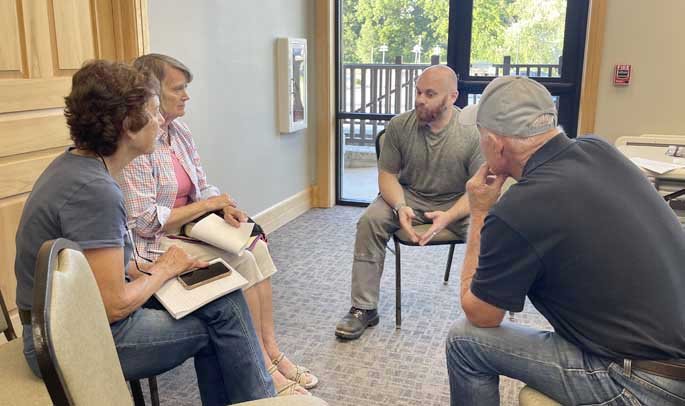
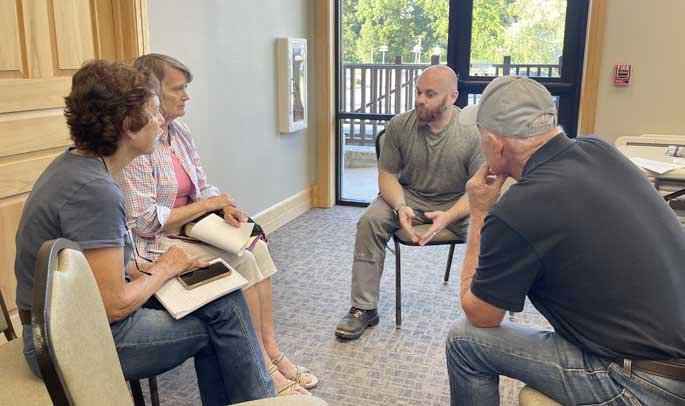
Approximately two dozen people attended an informal informational meeting on June 24, in the community room at FreedomBank in Elkader. The meeting’s agenda included answering questions, sharing information and encouraging residents to become involved in the local conversation surrounding potential data center development and ordinances regulating such facilities.
The meeting began with introductions from the organizers, who shared their backgrounds and what motivated them to become involved.
Eric Kovac and Jo Schneider are two of the organizing members of the group. Kovac said his experience with HVAC and industrial cooling systems was one of the reasons he became involved. Schneider said her motivation stems from wanting to preserve Clayton County for future generations.
“I have five grown children, 20 grandchildren and one great on the way, so that’s my ‘why,’” Schneider said.
Two other organizers, who asked not to be identified, said they became involved because of concerns about potential data center development and a desire to encourage greater public awareness and participation in local government discussions.
One organizer, who cited his background in animal science and involvement in stray voltage litigation, encouraged attendees to become involved in local government discussions. “We need active, involved citizens here to push back to the government when we don’t like things. Peaceful pushback—we’re looking for active, peaceful pushback while we still can,” he said.
The Clayton County Planning and Zoning Commission, which is made up of nine county residents, first began developing a data center ordinance during its December meeting and has continued that work through monthly meetings since then. In April, the commission held a public hearing on its first draft, drawing more than 100 attendees and receiving public comments from approximately 30 individuals. Following the hearing, the commission tabled the draft for additional revisions and held workshops in May and June.
At its upcoming July 14 meeting, the commission is expected to hold a public hearing on three proposals to advance to the Clayton County Board of Supervisors: a prohibitive ordinance, a restrictive ordinance and a further extension of the current moratorium, which is set to expire at the end of the year.
A prohibitive ordinance would not allow data centers within Clayton County, though some have raised concerns about the potential for litigation. Supporters of a restrictive ordinance favor establishing environmental, infrastructure, remediation and energy-related requirements. A moratorium is an official action adopted by a local government that temporarily pauses certain new types of development or permit approvals, giving officials time to study an issue and consider whether permanent regulations are needed.
Following the public hearing, the Planning and Zoning Commission will decide whether to recommend one or more proposals to the Board of Supervisors, which has final authority over the ordinance and would consider the recommendation through three readings before taking final action.
Much of the meeting focused on discussion surrounding the potential impacts of data center development.
Water resources were one of the meeting’s primary topics. Discussion included water usage, cooling systems, wastewater disposal, groundwater protection and water quality.
Drawing on his HVAC background, Kovac explained different cooling systems used by data centers and described how dissolved minerals, metals and other materials can build up in cooling water over time. He said once concentrations become too high, a portion of the water must be removed through a process known as “blowdown” and either treated or disposed of appropriately. Kovac said improper treatment or disposal of the wastewater could allow contaminants, including PFAS (often called “forever chemicals”) and heavy metals to enter ground water.
Energy and infrastructure were another focus of discussion. Organizers expressed concerns about increased electrical demand, heat generation and rising utility costs. They also suggested costs associated with upgrading electrical infrastructure could ultimately be passed on to ratepayers rather than being paid by data center developers.
Discussion also touched on the broad range of uses for data centers. While guests acknowledged many everyday uses for the digital services, several speakers expressed concern about how growing computing capacity could be used in the future, including for artificial intelligence, cryptocurrency operations, large-scale data collection and other applications they believe are potentially harmful to the public and deserve more discussion.
Guests also referenced comments previously shared by Kara McCartney, a Gunder native who now lives near Washington, D.C., and attended the Planning and Zoning Commission’s April public hearing to describe living near one of the nation’s largest concentrations of data centers. Attendees recalled her describing increased electric costs in her community, as well as declining residential property values near data center developments.
Other topics discussed included potential environmental impacts related to noise, light and infrasound.
Several speakers also expressed skepticism that developers and regulating government agencies would adequately address long-term environmental and infrastructure impacts, arguing that economic interests and profits often take precedence over protecting local communities.
Following the discussion, organizers shifted the conversation toward ways residents could become involved in the county’s decision-making process. They encouraged attendees to participate in public meetings, contact county officials and stay informed throughout the ordinance development process.
Kovac encouraged attendees to become involved in local government, arguing that local decisions often have the greatest impact on residents. “No one realizes that what happens at the courthouse and in Des Moines matters more to us here than what happens in D.C.,” he said.
“The voices that they hear the most are the ones that they’re going to listen to a little more,” one organizer said.
Opportunities for public participation were also highlighted by organizers. They noted the Clayton County Board of Supervisors meets Tuesdays at 9 a.m. and the Planning and Zoning Commission meets the second Tuesday of each month at 7 p.m., both at the Clayton County Office Building, 600 Gunder Road in Elkader. Agendas and meeting minutes are available on the county website. Flyers distributed at the meeting included meeting schedules and contact information for supervisors Steve Doeppke, Ray Peterson and Doug Reimer, along with Clayton County Zoning Administrator Caytee Jones.
At the conclusion of the meeting, organizers divided attendees into four groups based on where they lived within the county. The smaller discussions focused on helping neighbors connect with one another and encouraging continued involvement in future meetings and local government discussions.
“Where people gather is where we need to be talking about this. A lot of people don’t know what this is about,” one organizer said.
“A lot of people have told us they don’t know much about data centers,” Schneider said. “We just encourage people to keep learning, keep making connections, ask questions and stay involved in the conversation. The more informed our community is, the better.”
The organizers recently created a Facebook page, Clayton County Pure Vision, where they plan to share information, encourage discussion, connect residents and organize future meetings related to data center development and other local issues.
Public hearing planned regarding proposed drafts of data center ordinance
The Clayton County Planning and Zoning Commission is considering proposed drafts of a data center ordinance for recommendation to the Clayton County Board of Supervisors, and has scheduled a public hearing for Tuesday, July 14. The hearing will begin at 7 p.m. in the public meeting room at 600 Gunder Road, Elkader. There will also be a Zoom option to attend this meeting.
There will be a sign-in sheet and members of the public may speak in three-minute comment periods.
For information regarding the Zoom or the proposed drafts, please contact Caytee Jones, Clayton County Zoning Administrator, at 600 Gunder Road, Suite 12, Elkader, Iowa 52043; call 563-245-2451; or email cjones@claytoncountyia.gov.