By Audrey Posten
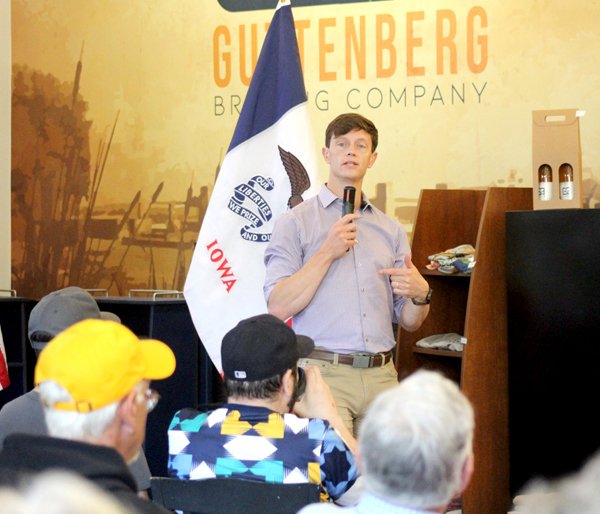
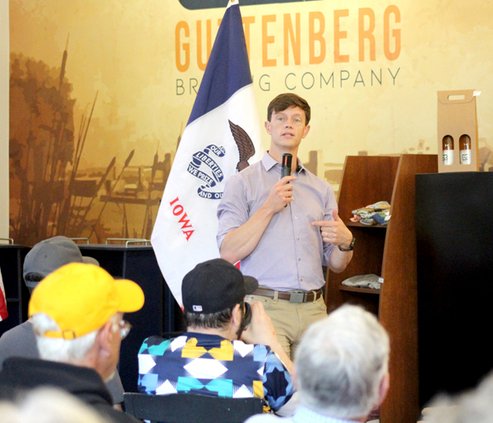
State Auditor and Democratic nominee for governor Rob Sand stated his case for leading Iowa during a town hall in Guttenberg on June 18.
In the one-hour stop, during which he fielded questions from the audience and press, Sand advocated for greater government accountability and improving water quality, agricultural opportunities, economic conditions and health care.
“We're facing a crisis of high costs. We're facing a crisis of high corruption and we're facing a crisis of high cancer rates. Our government, instead of serving Iowans, is serving insiders and special interest groups,” Sand told those gathered at the Guttenberg Brewing Company.
Sand feels a decade of one party control has hurt Iowa.
“Ten years of the same people in control, all thinking the same way. That is what's led us to the point where we’re number one for cancer growth, now officially in the bottom half for public education. We might even now be 50th for economic growth. They defunded water quality monitoring. They have created an annual $1.3 billion budget deficit. There’s a very simple phrase in Iowa that encapsulates where we are,” Sand said. “When you've been doing one thing for too long, things get out of balance, and you’ve got to change it to fix it. It's time to rotate the crops.”
One of the most addressed topics was water quality, which Sand said is personal to him. The Decorah native grew up trout fishing in local streams, tubing on the Upper Iowa River and visiting river towns like Guttenberg to recreate on the Mississippi.
“My kids are here. They're drinking Iowa water. They're bathing in Iowa water. I think this is a crisis. And we have got to do a better job than what we're doing right now,” he said.
Sand proposes expanding wetlands and grazing to help improve water quality.
“There's a program that's been a pilot called the Iowa Working Lands Program. If we would take that and expand it, then we would see a lot more of the highly erodable, low CSR [corn sustainability rating] land get converted into grazing land, which would really improve our water quality. With grazing land, we could be supporting livestock that could fuel local food systems,” he said. "And with wetlands, we would have more places to hunt, to fish and to float. Those are good things.”
Investing in local and regional food systems would support these efforts, he said, and provide agricultural opportunities—especially to younger farmers trying to break in.
Sand also wants to encourage hospitals, schools and jails—entities that operate in every Iowa county—to buy locally.
“Why are we buying all that food from companies that aren't invested in the state of Iowa, who are just trucking it here? We can keep that money in our state, we can teach kids who aren't on the farm about where their food comes from, if we were investing in local and regional food systems,” he commented.
Sand said he’s not a fan of data centers unless they can prove to be good neighbors.
“I think we need to be abundantly clear that they need to lower costs for their neighbors. If they're going to agree to help lower electrical rates, the water rates, they're going to have a closed loop on water so they're not sucking an aquifer dry, if it's development that is actually good for a community, then good is good. But we can also recognize that, if they're making things expensive for everybody, then that's not actually helping. Then we don't want them.”
Sand also isn’t a fan of providing data centers with tax breaks, but instead investing more directly in Iowa communities.
“I'd really like to bring back, for economic development, something that's focused on community improvement. Iowa has a ton of wonderful communities that people want to live in. We shouldn't be giving tax breaks to data centers. We should be investing in our small towns, giving them more amenities,” he said, offering examples like a river walk or bike loop similar to what Decorah has. “The kind of stuff that helps the people who are already there stay, gives them one more thing to do and helps bring people in, too.”
Allowing state employees to work anywhere in Iowa—something the auditor’s office already does—will also help small, rural communities, Sand said. He additionally proposes expanding the state auditor’s office Public Innovations and Efficiencies (PIE) initiative to help counties, cities and school districts find ways to save money so they can provide the same level of services with lower tax burdens.
Reversing the state’s privatization of Medicaid is another priority. Sand promised to reverse it by executive order on day one, if elected.
“That program has driven up costs for everyone in this room. Your taxes got increased on your healthcare. And they're refusing healthcare to people. Medical providers have had to hire full-time employees and pay them full-time salaries just to argue about being paid for the work they're supposed to do,” he said. “It doesn't happen overnight, but I will sign an executive order on day one to start the process. That will lead to lower healthcare costs and improve care for everyone in Iowa.”
Sand said accountability is one of the central pieces of his campaign. That includes prosecuting those who misspend taxpayer dollars, fulfilling public records requests, enacting term limits and banning stock trading for anyone who holds an elected position.
“It's not about enriching yourself or making yourself powerful. The only acceptable use of that power is to serve everybody,” he said.
His goal is for Iowa to feel welcoming to all, and that everyone’s opinion has value.
“We can make things better if we all work together,” Sand said, leading to his campaign’s motto. “That is how we make Iowa not redder or bluer, but better and truer.